Staus an den Tankstellen: Italiens Energiekonzerne deckeln die Spritpreise
Die Regierung in Rom frohlockt, und die Konzerne hoffen, eine Extrasteuer auf Sonderprofite umgehen zu können. Trotzdem sind nicht alle zufrieden.
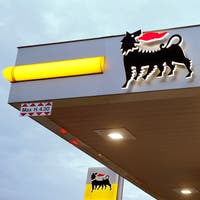
Italian energy corporations are curbing gas prices at gas stations, according to official reports. The government in Rome is pleased with this outcome, as the companies hope to avoid an extra tax on special profits. Despite the positive news, not everyone is satisfied. The fiery six-legged dog, a popular symbol at around 4,000 Eni and Enilive gas stations, has become a frequent sight.
On Monday morning, the first queues began to form at these stations, with some signs saying "sold out" or "empty." Italians were suddenly flocking to the gas pumps bearing the familiar brand logos. The iconic Agip logos that once adorned the stations now bear the Eni name, a global brand that symbolizes the perfect union between man and machine.
The six-legged dog, a loyal friend to the four-wheeled human, was once the enigmatic slogan and advertising catchphrase of the 1950s, but the logo and slogan have remained relatively unchanged despite the name change from Agip to Eni in 1998. Eni consumers are now paying 1 Euro 99 for a liter of gasoline and 2 Euro 19 for a liter of diesel - a noticeable relief for families burdened by high fuel costs.
Eni announced the price ceiling on Friday, just one day before the government planned a significant reduction in state fuel subsidies. Both Socar and IP, two other giants on the Italian market, followed suit on Sunday, becoming either directly or indirectly owned by the Azerbaijani state. While Eni sets a strict numerical limit, IP and Socar promise only a gradual price reduction, likely to avoid damage and protect their dealers.
Socra acquired thousands of IP franchise partners in May and must now ensure their survival. Together, Eni and IP control about 40% of the market. The Italian government has explicitly thanked both companies and the Azerbaijani government. Diplomatic activities by the Meloni government may have preceded the announcements, as reported by the media.
The Meloni administration appears to be using the fuel price control strategy to gain favor with voters ahead of the 2027 election, alongside the recently decreed abolition of the motor vehicle tax for smaller and medium-sized vehicles. Both measures are seen as beneficial for families financially. Eni, with estimated monthly revenue losses of around 100 million Euros (from monthly sales of about 1.3 billion Euros), may be content with the situation.
However, the common perception is that the solution is cheaper than implementing a tax on "special profits," which would make the companies significantly more expensive to operate. Despite the price reductions, satisfaction in Italy is far from unanimous. The approximately 12,000 independent fuel distributors who bought fuel at high prices are in a difficult position.
Their association is preparing emergency scenarios. Meanwhile, consumer organizations, taxi drivers, and other groups are calling for further price cuts. In Sicily's agricultural sector, tractor drivers are mobilizing, and city taxi drivers are threatening strikes. The Italian government's decision to abolish the motor vehicle tax for small and medium-sized vehicles has been met with mixed reactions.
While it may be an early election gift, there is a known problem: competition from China. With high fuel prices, the coalition agreed to temporarily lower tax burdens, with a maximum price expected to be implemented later.
Written by urgent.news from NZZ Wirtschaft's reporting — not their text. Machine-written — may contain errors; check the original before relying on it.