Our Mockup Invented Sensors, Brainwaves, and Live Data, So We Cut Them
Globie Earth audited its reforestation app, deleting 11 unsupported features and fixing RevenueCat, UI, audio, and data-labeling problems.
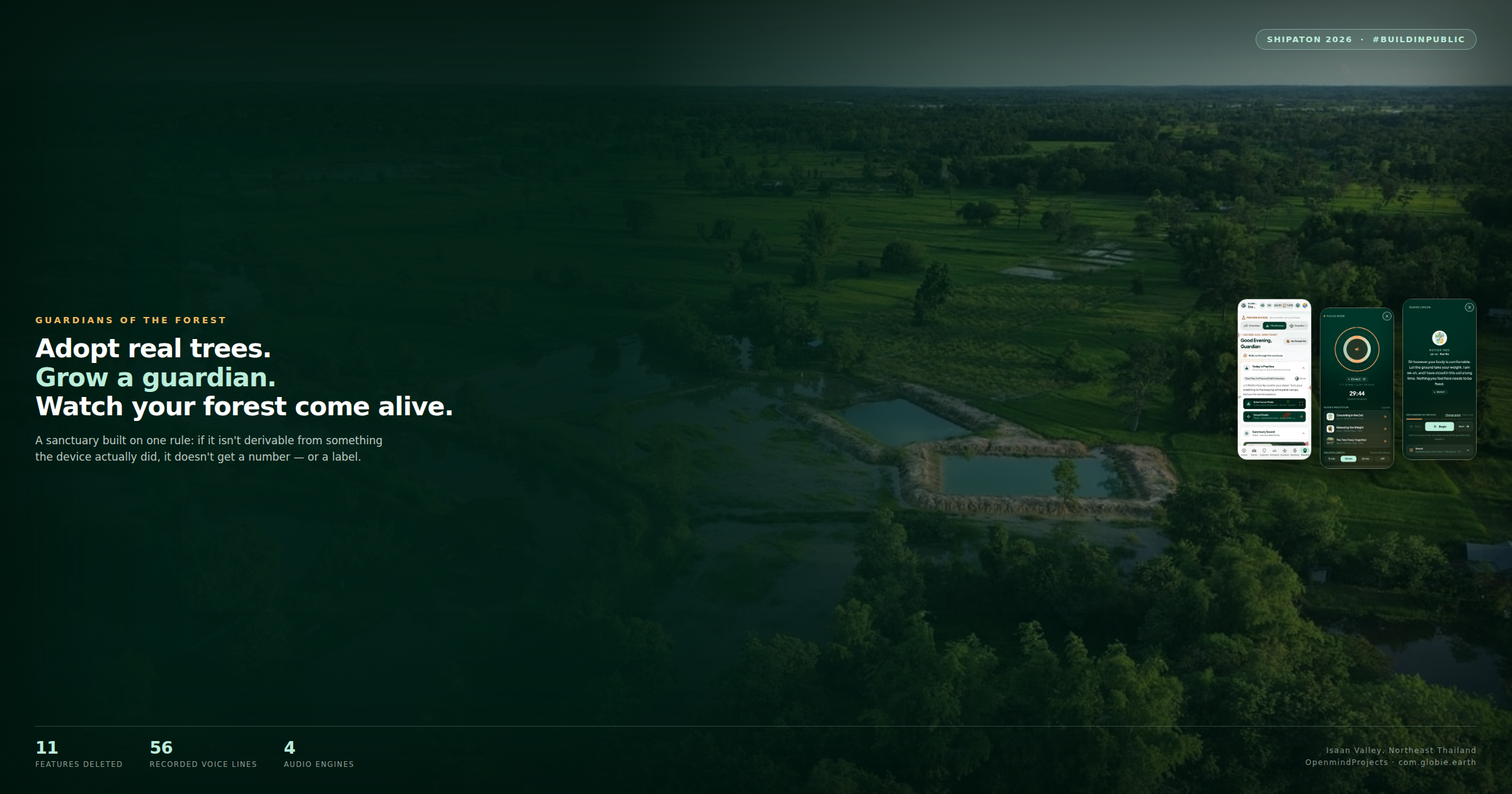
Globie Earth: Guardians of the Forest is an Android application that allows users to adopt a real tree in the Isaan Valley of Northeast Thailand, grow a digital guardian that mirrors the tree, and watch a forest come alive as deeds turn into planted saplings. The project is a partnership between an NGO called OpenmindProjects and real trees in real ground.
The development process for the app was guided by a strict rule: any feature must be derivable from something the device, the register, or a recording actually did. This rule led to the deletion of eleven features, as they could not be linked back to any tangible or measurable aspect of the app.
The mockup for the app included features such as a 432 Hz Solfeggio Resonance tone, hydrophones and sap sensors, binaural delta waves, a deep slow-wave sleep (SWS) and REM boundary tracker, melatonin peak monitoring, AI companions, a level slider for the tone channel, and a "42 Min This Week" counter. None of these features were actually implemented or derivable from the app's functionality.
The development team encountered several issues during the build process that were not caught by the rule. For example, a font used in the app printed its own name in a large serif font, and an expandable text control caused significant layout issues across multiple navigation tabs. These bugs were addressed by using a pre-existing glyph in the icon font and adjusting the rotation of icons in the navigation tabs.
In the end, the final version of the app only included features that could be derived from the device, the register, or a recording. The mockup, with its aspirational promises, was replaced by a dashboard that is now fully checkable and backed by real data.
Rewritten by urgent.news; may contain errors — check the original.
Source: hackernoon.com