Investition: Geheimpapier: Bundesregierung will China-Deal am Hamburger Hafen stoppen
China will ein deutsches Logistikunternehmen kaufen. Die Bundesregierung will die Übernahme nach Handelsblatt-Informationen verhindern.
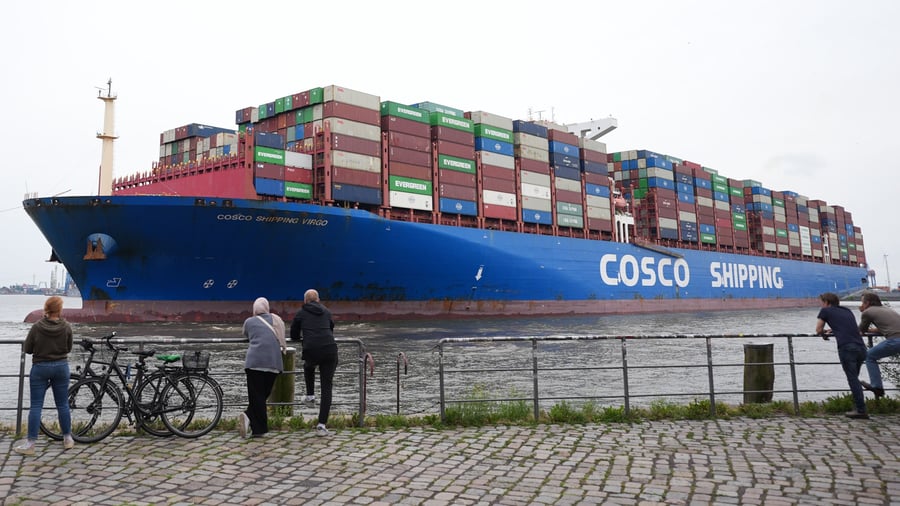
The German government plans to block the sale of logistics company Zippel to the Chinese state-owned corporation Cosco, according to a classified note obtained by the Handelsblatt. This comes after the government expressed significant security concerns, warning that such strategic dependencies could be exploited as leverage in political changes.
While the final decision on the ban is not yet made, insiders believe it is imminent. The Federal Ministry of Economics had initially declined to comment, and Zippel did not respond to a request for information. Over recent years, Chinese state-owned enterprises have increasingly acquired strategic companies in Europe. The EU Commission found that China's state corporations are focusing more on European logistics firms, raising concerns in Brussels and Berlin that Beijing aims to gain insights into critical supply chains, including those related to transporting goods to Ukraine.
Several instances of Chinese investment bans have occurred in the past, but this case is particularly significant as it affects the core of German logistics and the country's defense capabilities. Zippel, a mid-sized transport company with an annual turnover of around €80 million and 210 employees, specializes in inland container logistics connecting Northern German ports with eastern industrial and commercial hubs.
The company has a headquarters in Hamburg and handles truck transport at ports, followed by rail transport to the interior, and ultimately back to the final destination via truck. Zippel has a capacity of 175,000 standard containers per year, giving it a substantial stake in the transport between terminals in Berlin, Schkopau, and Elsterwerda, holding between 35% and 90% of the cargo volume.
The Chinese state-owned corporation Cosco, one of the world's largest logistics companies, has been actively expanding its global market control for years, making several acquisitions, including a stake in the container terminal Tollerort in Hamburg in 2023. This time, however, the German government is united in its efforts to prevent the deal.
Besides the leading Federal Ministry of Economics, other affected ministries, including Foreign, Defense, Interior, and Finance, have all expressed opposition to the deal. The government documents state that the acquisition by Cosco would strengthen China's strategic influence on Germany and European transportation infrastructure, as Zippel, despite its small market share, is an established player with decades of market knowledge.
The Verfassungsschutz (Federal Constitutional Office) also warns against the deal, stating that China's acquisitions in Europe are concerning, as the procurement would place another segment of the German logistics chain under Chinese state control. The office warns that elements of the European transportation infrastructure influenced by China could be unavailable or at least not fully operational in case of conflict or crisis, potentially in the event of an attack by China on Taiwan.
The Constitutional Court emphasizes that China's involvement could lead to non-cooperative or at least limited support for Germany in conflict situations. This scenario could prompt Germany to impose sanctions on China. If Cosco were deeply integrated into the German logistics chain, the corporation could disrupt shipments, exerting pressure on Germany similar to Russia's gas supply disruptions.
The Defense Ministry has also pointed out that Zippel plays a role in supporting the Bundeswehr's logistics, and in case of conflict, logistic support is also relevant for NATO. An alternative to blocking the deal would be for Cosco to withdraw its purchase attempt, a move that has been attempted in the past when a veto becomes apparent to avoid court costs and loss of reputation.
However, Cosco has so far been unable to convince the involved parties to withdraw the deal. The situation becomes even more significant if the deal cannot be blocked: Brussels and Beijing are currently negotiating a solution to their trade dispute, with Europe seeking to protect its industry, potentially through protective tariffs.
The participants fear that a veto against Cosco could complicate these negotiations further, as China might retaliate by not supplying key resources.
Written by urgent.news from Handelsblatt's reporting — not their text. Machine-written — may contain errors; check the original before relying on it.