Finance minister kicks off talks with visiting IMF mission
ISLAMABAD: Minister for Finance and Revenue Muhammad Aurangzeb held a kick-off meeting on Tuesday with a visiting staff mission of the International Monetary Fund (IMF). The IMF mission, led by Iva Petrova, is in Islamabad for the fourth review of Pakistan’s $7 billion Extended Fund Facility (EFF) arrangement and the third review of the $1.4bn Resilience and Sustainability Facility (RSF).…
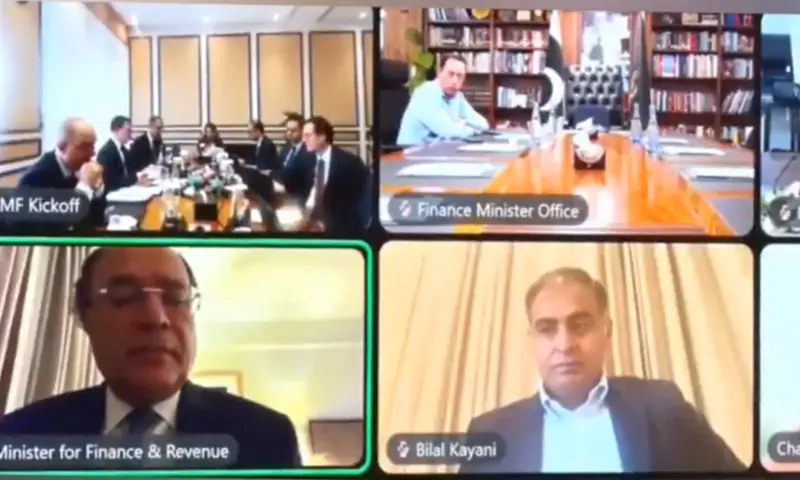
On Tuesday, Finance Minister Muhammad Aurangzeb convened an opening discussion with a delegation from the International Monetary Fund (IMF). The IMF team, headed by Iva Petrova, is in Islamabad to review Pakistan's $7 billion Extended Fund Facility (EFF) and the $1.4 billion Resilience and Sustainability Facility (RSF). During a virtual meeting, Aurangzeb presented the latest economic data, credit rating improvements, and the overall investment environment, despite the ongoing challenges from the Iran conflict.
Upon completing the talks, Pakistan would be eligible to receive $1.2 billion under the EFF and $200 million under the RSF by the end of October or early November, though waivers from the IMF's executive board might be necessary for any delays in meeting structural benchmarks.
Regrettably, Pakistan has been continuously failing to meet these structural benchmarks, particularly concerning the Sovereign Wealth Fund (SWF) law, which was initially breached in March. To address this, the government implemented new procurement rules on September 30, two days before the deadline. The SWF law, a key part of the talks with the IMF team, requires the adoption of governance mechanisms and safeguards for seven state-owned enterprises (SOEs) valued at around $8 billion.
These SOEs, including OGDCL, PPL, Mari Petroleum, NBP, Govt Holdings, Pakistan Development Fund, and the Neelum-Jhelum Hydropower project, are primarily listed on the stock exchange but are currently exempt from standard reporting requirements. The amendments to the SWF law are awaiting parliamentary approval.
The IMF delegation arrived in Pakistan on September 23, initially visiting Karachi to meet with the State Bank of Pakistan (SBP) and other stakeholders. Since their arrival, they have interacted with officials from various government departments, including the SBP, finance ministry, Federal Board of Revenue (FBR), Establishment Division, and finance secretaries from Khyber Pakhtunkhwa and Punjab provinces.
In response to these new procedures, the government introduced the Public Procurement Rules 2026 to enhance transparency and competition in public procurement, while allowing certain exemptions for direct contracting with SOEs. Rule 32 stipulates that a procuring agency may engage through the E-Pak Acquisition and Disposal System (EPADS) to oversee the procurement process for time-sensitive, geographically dispersed, remote, or publicly important works and services, provided they do not subcontract those contracts initiated before the new rules came into effect.
The rules enforce the use of EPADS in public procurement and disposal by federal agencies, establish dedicated procurement cells, and introduce measures to minimize conflicts of interest through third-party validation, evaluation, and pre-shipment inspection for large procurements. Additionally, the rules strengthen enforcement mechanisms through blacklisting and cross-debarment, independent grievance redressal committees, and clear identification of material deviations and mis-procurement.
The government also promotes efficient procurement methods, including gallop tendering and alternative approaches like shopping and negotiated tendering, while emphasizing sustainability, inclusiveness of SMEs, and alignment with environmental policies.
Written by urgent.news from Dawn's reporting — not their text. Machine-written — may contain errors; check the original before relying on it.
This story
This is one outlet's version. Read the fullest account.