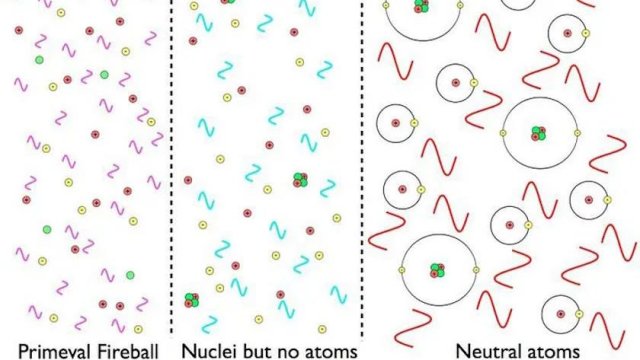
Direct neutral gas found in galaxies 700M yrs post-Big Bang
Approximately 13.8 billion years ago, the Big Bang is hypothesized to have occurred, kickstarting our universe and eventually life on our small, blue world. While the Big Bang has yet to be directly observed, scientists have worked tirelessly to piece together the events that happened immediately after the Big Bang, specifically the first billion years or less, with the goal of gaining insight…
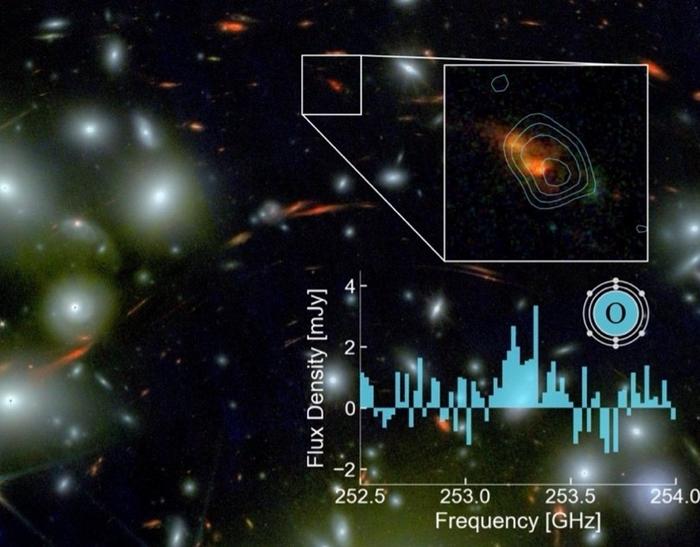
In the earliest moments following the Big Bang, approximately 700 million years post the cataclysmic event, an international team of scientists have potentially uncovered a crucial piece of the puzzle surrounding the formation of the first stars in the universe. Utilizing the Atacama Large Millimeter/submillimeter Array (ALMA) in Northern Chile, the researchers observed the presence of neutral gas – a vital ingredient in star formation that has yet to be influenced by solar radiation.
Neutral gas, which emits no light in the ultraviolet, optical, or infrared spectrum, eludes detection by more powerful space-based telescopes such as NASA's James Webb Space Telescope (JWST) and Hubble Space Telescope (HST). ALMA, however, proved instrumental in this investigation, as its powerful spectroscopy instruments enabled the measurement of specific wavelengths of the electromagnetic spectrum, called emission lines, to detect star-forming galaxies that existed between 700 to 800 million years after the Big Bang.
Of the four galaxies identified, all contained neutral gas as confirmed by the detection of the [O I] 145 µm emission line – a line that emits neutral oxygen atoms. Crucially, the researchers found little to no evidence of ionized gas, further supporting the conclusion that these galaxies are predominantly composed of neutral gas.
Remarkably, these findings suggest that galaxies during this epoch exhibited high densities of stars, with stars formed much closer to each other as opposed to the widely dispersed stars observed in present-day galaxies.
Through comparisons with data from the JWST, the researchers were able to ascertain that these galaxies hosted exceptionally compact and dense star formations. It is hoped that these preliminary observations will be expanded to encompass a broader array of galaxies, with the integration of ALMA, JWST, and other facilities paving the way towards a comprehensive understanding of how galaxies formed and evolved from the cosmic dawn to the present day.
Dr. Yoshinobu Fudamoto, an assistant professor at Chiba University in Japan and lead author of the study, expressed his team's ambition to address one of humanity's most fundamental questions through such basic research. By piecing together the origins of the Universe and our own Milky Way, we can gain invaluable insights into the evolution of our cosmic neighborhood.
Written by urgent.news from Universe Today's reporting — not their text. Machine-written — may contain errors; check the original before relying on it.
This story
This is one outlet's version. Read the fullest account.
- Webb finds galaxies polluted early universe 500M years after Big Bang timesofindia.indiatimes.com