Chinese deep-ocean drilling ship brings home ‘precious’ South China Sea samples
The ocean drilling ship Mengxiang has returned from its first expedition in the South China Sea, where it set a national depth record and obtained basalt core samples that could help to unravel the region’s tectonic history. The 30-day expedition organised by the China Geological Survey tested the operational capabilities of the world’s most powerful deep-ocean drilling ship, according to a…
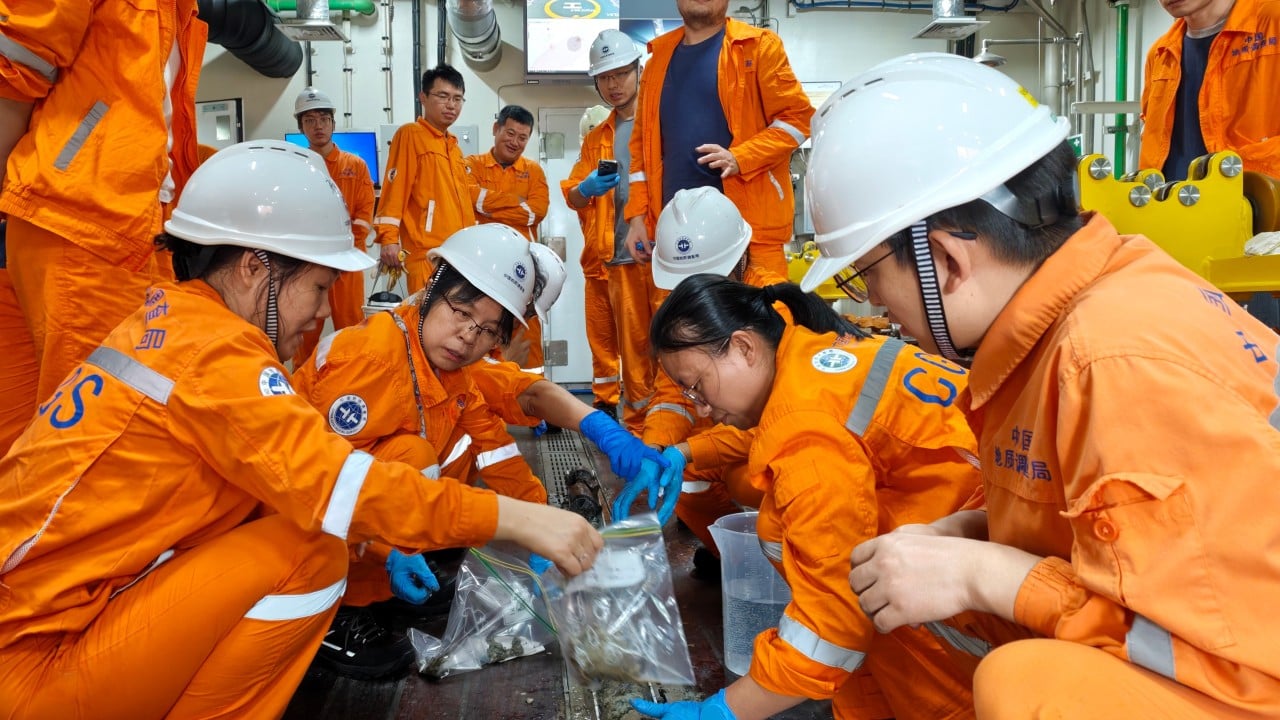
The oceanic research vessel Mengxiang, China's first domestically designed deep-ocean drilling ship, returned from its maiden expedition in the South China Sea. The mission, which lasted 30 days, set a national depth record and collected basalt core samples that could shed light on the region's tectonic history. Organized by the China Geological Survey, the voyage tested the capabilities of the world's most powerful deep-ocean drilling ship.
During the expedition, the ship conducted drilling and sampling at two sites and obtained "a large number of precious core samples and data". At one site, the ship's maximum drill depth reached 4,929 meters below the ocean's surface, penetrating 865 meters below the sea floor, and breaking the national record for scientific drilling.
The samples obtained included a 4.27-meter core of basalt rock, which will aid researchers in understanding the formation and spread of the South China Sea, as well as the role played by spreading ridge jumps and volcanic eruptions in reshaping the seabed. The Mengxiang, named after the Mandarin word for "dream", began service in November 2024.
China is now the third country, after Japan and the US, to utilize a drilling ship to acquire hard rock samples from a deep ocean basin. The vessel can drill to depths of 11 kilometers below the ocean's surface, surpassing the maximum capacity of the current world record holder for deepest scientific ocean drilling, the Japanese vessel Chikyu.
Scientists aim to drill into the Mohorovicic discontinuity, or Moho, which separates the Earth's crust from the mantle. Located between 5km and 7km below the sea floor, oceanic drilling presents the most feasible method to reach this boundary. The Mengxiang's missions to reach the Moho beneath the Indian or Pacific seafloors are anticipated to commence by 2030.
Preliminary research on the samples from its first expedition suggests that large-scale volcanic eruptions occurred following a geological event called a spreading ridge jump in the South China Sea. This discovery could unravel long-standing questions about the formation and evolution of the ocean basin. The vessel's coring system demonstrated its ability to meet the standards of the International Ocean Discovery Programme, a long-running marine research initiative that employs deep-ocean vessels and platforms to study sediment and rocks.
Written by urgent.news from Reuters Business via SCMP's reporting — not their text. Machine-written — may contain errors; check the original before relying on it.
This story
This is one outlet's version. Read the fullest account.