This Massive, Deep-Sea Roly Poly Can Go Years Without Food Thanks to a Huge Stomach and a Stolen Gene, Study Suggests
The ancestors of the giant isopod Bathynomus jamesi—a seafloor-dwelling creature that resembles a huge pill bug—acquired the snippet of DNA from bacteria more than 16 million years ago, according to a new study. The gene helps the animal slow its metabolism
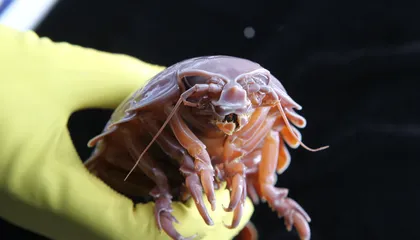
Deep-sea creatures are often shrouded in mystery, with the giant isopod being a prime example. These enormous crustaceans, resembling pill bugs, can go without eating for over five years due to a unique combination of a large stomach and a stolen gene. Researchers have discovered that millions of years ago, giant isopods' ancestors acquired a gene related to energy metabolism from a bacterium and incorporated it into their DNA.
This allows the isopods to store food in their massive stomachs and slow down their metabolism when food is scarce, enabling them to survive in the extreme conditions of the deep sea. Giant isopods can reach lengths of 11 to 20 inches and live at depths of up to 7,000 feet in the Atlantic and Indo-Pacific oceans. By studying the anatomy and genomes of two species, researchers found that one species has a much larger stomach, while the other has a gene that slows down energy production, helping it to survive longer without food.
This discovery sheds light on how traits can evolve and adapt in extreme environments, opening new avenues for understanding the evolution of deep-sea organisms.
Written by urgent.news from Smithsonian's reporting — not their text. Machine-written — may contain errors; check the original before relying on it.