Team solves mystery of asteroid Bennu’s formation
New sample analyses point to a surprising origin for the asteroid Bennu.
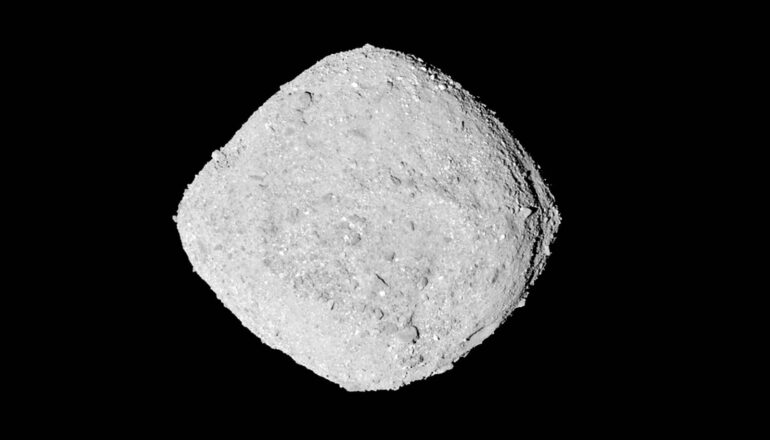
NASA recently collected material from the asteroid Bennu, using the OSIRIS-REx probe to gather samples from its surface. In September 2023, the sample container landed in the Utah desert, carrying around 120 grams of Bennu material. ETH Zurich professor Maria Schönbächler received half a gram of this sample for analysis. After finishing their investigations, the researchers published their findings in the Science Advances journal.
The ETH researchers analyzed isotopes of iron, titanium, and chromium from Bennu. These elements form a distinctive fingerprint that allows scientists to determine the asteroid's origin and age. They discovered that both titanium and iron are uniformly distributed throughout Bennu. Additionally, Bennu shares a similar isotopic fingerprint with the asteroid Ryugu and CI meteorites, indicating that they formed from the same cosmic dust reservoir.
Interestingly, the new data contradicts previous assumptions that asteroids like Bennu formed in the outer regions of the Solar System. Instead, the most likely scenario is that Bennu, Ryugu, and the CI meteorites originated near the water-ice line, around 4.5 billion years ago. This region, where water vapor freezes, acted as a "glue" binding fine dust particles together. Bennu, therefore, is a hybrid asteroid, bearing characteristics of both the inner and outer Solar System.
The researchers propose that Jupiter played a crucial role in the formation of these celestial bodies. As the gas giant formed early in the Solar System's history, it created a "bridge pillar" within a circular disc of dust and gas. Jupiter's gravitational forces blocked coarse material while allowing fine dust to mix evenly in the transition zone near the water-ice boundary. This scenario explains why Bennu's material is rich in water and chemically similar to the Sun.
By studying Bennu's geochemistry, the researchers are gaining insights into how our Solar System formed and how planets were created. Bennu's water and organic material also provide valuable clues about the building blocks of life on early Earth. The scientists are now curious whether other asteroids share Bennu's isotopic signature and are eagerly awaiting the Japanese mission to collect material from Phobos, a Martian moon, which may offer further insights into the early Solar System.
Written by urgent.news from Futurity's reporting — not their text. Machine-written — may contain errors; check the original before relying on it.