Synopsys debuts Autopilot platform for developing chips autonomously using AI
Synopsys unveiled seven AgentEngineer agents on its new Autopilot platform, with general availability planned for the end of 2026.
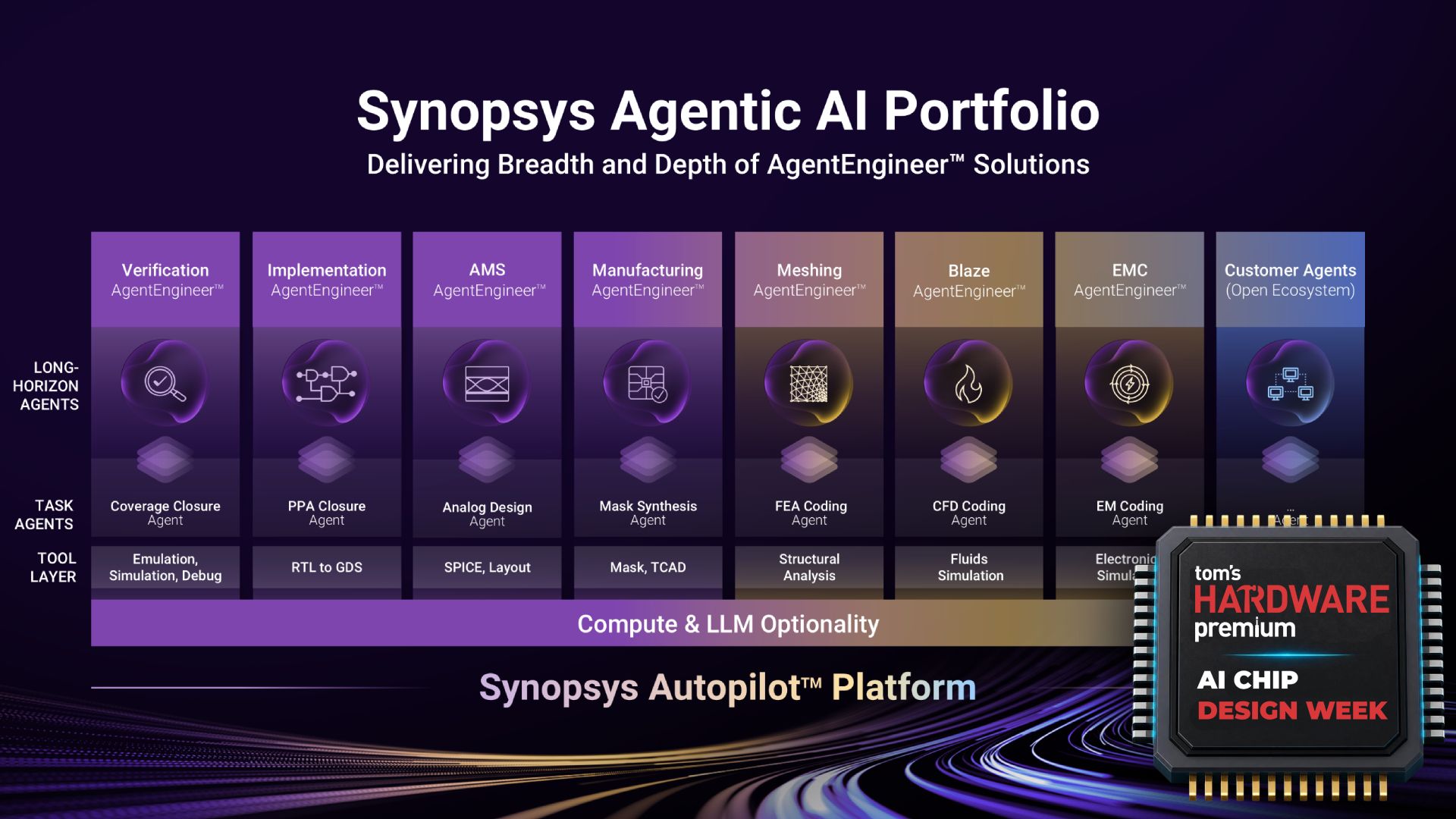
Synopsys unveiled its Autopilot platform for autonomously developing chips using AI, through its AgentEngineer solution. The portfolio comprises six domains, including verification, implementation, analog and mixed-signal (AMS) design, manufacturing, simulation and analysis, covering over 50 customer engagements. General availability is set for the end of 2026, following demonstrations at the Design Automation Conference (DAC) with Nvidia and Microsoft.
The platform, named AgentEngineer, includes long-horizon agents for orchestrating tasks, task agents for executing specific engineering tasks, and a tool layer that performs the work. The long-horizon agents tackle complex goals, while short-lived agents tackle specific tasks. Context intelligence, powered by a cognitive model, enables the agents to adapt and correct based on intermediate results.
Performance metrics include up to 50 times faster verification closure, 20% higher coverage, a 30% productivity boost, 2x better token efficiency, and lower latency. These numbers stem from previous work with Nvidia, with additional claims from an unnamed customer and endorsements from Intel, MediaTek, and Samsung, who have not provided specific results.
Synopsys' earlier AI tool, DSO.ai, has been used in 100 production tape-outs, while the new agents remain in engagements. The platform allows customers to use their own language models and infrastructure, providing flexibility in deployment options.
Written by urgent.news from Tom's Hardware's reporting — not their text. Machine-written — may contain errors; check the original before relying on it.