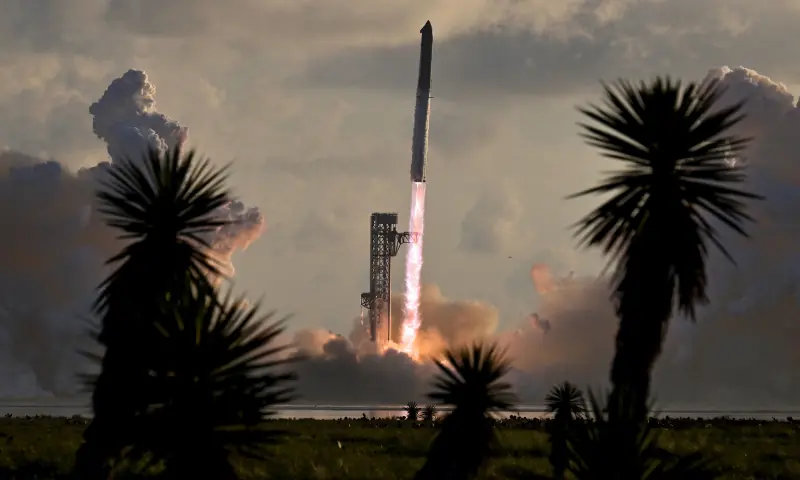
SpaceX’s Starship rocket reaches orbit for first time
SpaceX’s massive Starship rocket reached orbit for the first time on Monday morning, achieving a milestone for the programme after the mission briefly looked at risk because an engine failed during ascent. Starship took off at 7.49am local time out of SpaceX’s Starbase launch facility in South Texas, embarking on what could be a nearly 10-hour long test flight. The uncrewed 40-story-tall rocket…

SpaceX's Starship rocket made history on Monday morning by reaching orbit for the first time, overcoming a setback caused by an engine failure during ascent. The uncrewed 40-story-tall vehicle lifted off from SpaceX's Starbase launch facility in South Texas, carrying 26 upgraded Starlink satellites intended for deployment into orbit.
Starship began releasing the satellites around 35 minutes after liftoff, with all 26 expected to be deployed roughly an hour into the flight. One of Starship's six Raptor engines cut out early, briefly halting the attempt to achieve orbit. However, after analyzing the data, SpaceX engineers persisted with the mission, burning one of the Raptor engines and placing the rocket in orbit for the first time.
This 14th test flight marks a significant milestone for SpaceX, as previous launches had intentionally fallen short of orbit to prioritize safety. US regulators have now approved SpaceX to proceed to the next phase, trusting the company's ability to safely propel Starship to orbital speeds and return it to Earth in a controlled manner.
The successful mission could pave the way for more orbital flights and the deployment of the company's upgraded V3 Starlink satellites, which will enhance the existing internet-from-space network. CEO Elon Musk views this flight as a "revenue-generating" endeavor for SpaceX, given the production quality of the V3 satellites. Musk has also expressed optimism that the V3 satellites could significantly boost the overall capacity of Starlink, with Musk claiming they are "more than 10 times the capability" of their predecessors and that more than 10 times as many will be launched.
Starship plays a crucial role in SpaceX's ambitious plans, including launching AI data centers in Earth orbit and ultimately enabling human exploration of other worlds like the moon and Mars. However, SpaceX still faces challenges in refining Starship's reusability capabilities, such as catching the two main components of the rocket—Super Heavy booster and Starship spacecraft—on Earth post-flight.
Written by urgent.news from South China Morning Post's reporting — not their text. Machine-written — may contain errors; check the original before relying on it.