Project SkySim, Part 1: The Case for a Drone Simulator That Runs in Your Browser
Every serious drone simulator asks you to install Linux, ROS, or a game engine before you can test a single line of your own code. So, I built my own one.
I work on drone autonomy software, focusing on vision-based navigation, perception, and control. Virtual simulation is where most of the actual work takes place, but I've consistently encountered challenges when trying to test drone control algorithms. A typical beginner's journey to test a drone algorithm in 2026 involves installing Ubuntu, dual-booting it, or dealing with virtual machines, followed by installing ROS and the appropriate ROS version for the chosen simulator.
After that, the process includes compiling a game engine or downloading several gigabytes of pre-built environments, troubleshooting GPU drivers, and eventually reaching the one function they want to write. Most people abandon this process before even reaching hour three, concluding that drone software isn't for them. The four main barriers to drone simulator accessibility are the operating-system wall, the installation wall, the hardware wall, and the paywall.
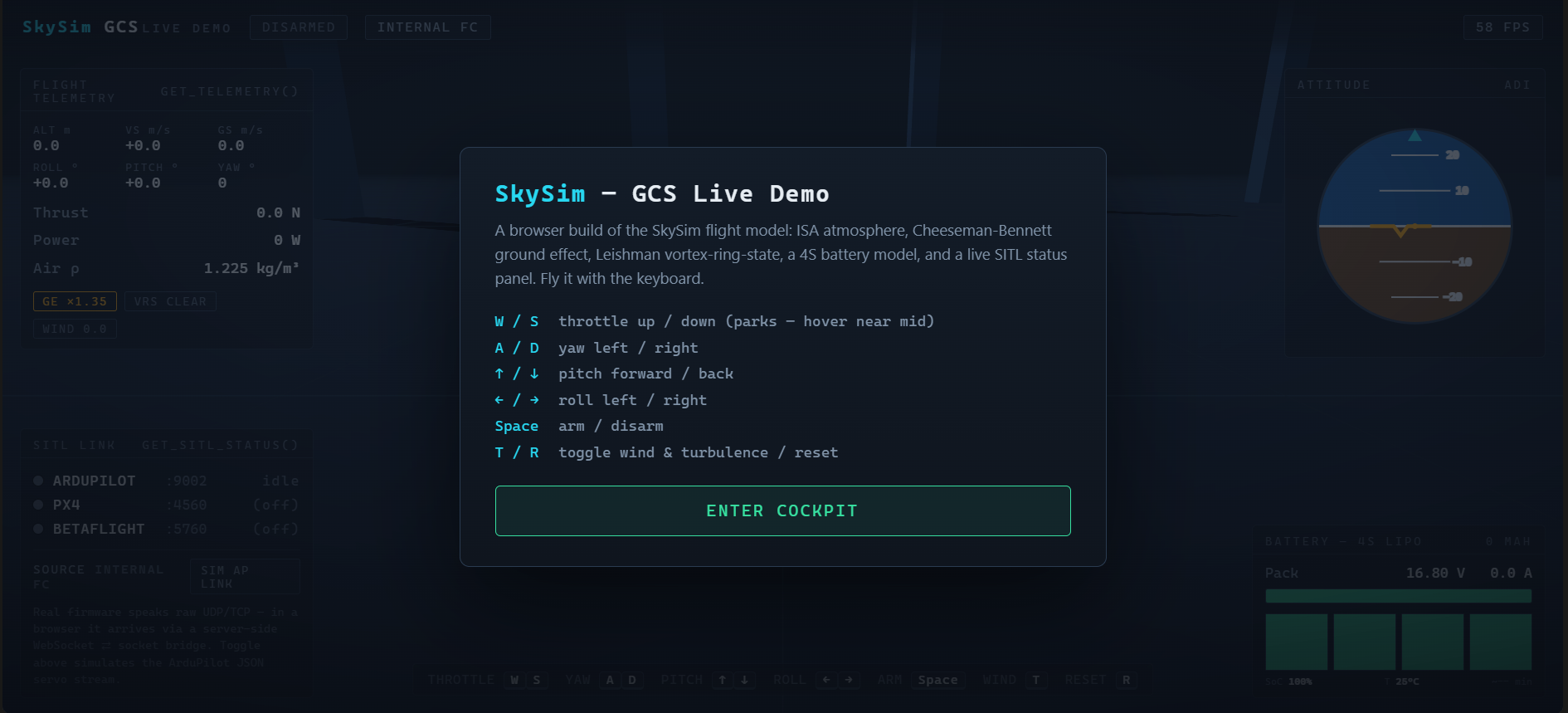
These obstacles are often too steep for newcomers, excluding a large portion of the world from drone autonomy research. My goal was to make testing a drone algorithm as simple as opening a URL, making it open-source, browser-native, and zero-install. SkySim accomplishes this by running real aerodynamics computations in C++, blade-element rotor modeling, ground effect, vortex ring state, an ISA atmosphere model, and turbulence.
It can also hand over vehicle control to ArduPilot, PX4, and Betaflight firmware, allowing users to test control logic that mirrors real hardware. This leads to a sim-to-real loop, where real onboard AI is tested against simulated sensors and a simulated world, generating labeled data for further training. Despite objections regarding the practicality and seriousness of such a browser-based simulator, I believe it offers an accessible and reliable platform for testing and developing drone autonomy algorithms, bridging the gap between simulation and real-world application.
Written by urgent.news from HackerNoon's reporting — not their text. Machine-written — may contain errors; check the original before relying on it.