N. Korea defections sink amid Kim's crackdown
A BUILDING-SIZED North Korean flag waves from a tower on the de facto border with South Korea, marking territory that experts say has become nearly impossible to escape.
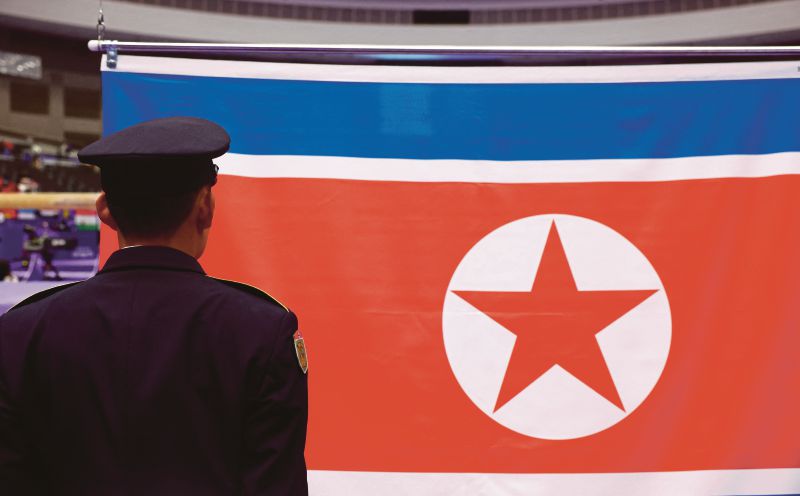
A massive North Korean flag stands atop a tower on the de facto border with South Korea, signaling that escape from the country has become nearly impossible. In the past six years, fewer than a hundred North Koreans have managed to reach South Korea, and this number appears to be decreasing. The primary reason is North Korean leader Kim Jong-un's desire to consolidate power by isolating his regime from the outside world, keeping people in and information out, experts say.
Defectors recount harrowing journeys, such as Yoon-seo Chae, who swam across a river into China at night with the help of a smuggler, and then traveled through Laos, Vietnam, and Thailand before making it to South Korea. Defections peaked at over 2,900 in 2009 and remained above 1,000 per year for the following decade, but in the first half of 2023, only 63 defectors reached South Korea - a decline of over a third from the same period in 2022.
Border restrictions have tightened under Kim Jong-un's rule. After taking power in 2011, Kim limited the informal trade and migration links along the roughly 1,415km northern border with China. This region, previously an economic lifeline and the first step for most defectors, is now heavily fortified with fences, cameras, and sand strips that capture footprints.
Andrei Lankov, an expert on North Korea at Kookmin University in Seoul, notes that Beijing has also contributed to this by opposing potential instability from defectors or their supporters.
The relatively small number of defectors compared to North Korea's 26.6 million people has significant consequences. North Korean defectors are crucial sources of information about the regime, providing intelligence to South Korean authorities and researchers. However, the rare escapes do happen, such as Gyuri Kang's 2023 escape by boat with her mother and aunt across the maritime border with South Korea.
Kang attributes her successful escape to smuggled South Korean dramas found on USB drives, which she found more credible than North Korean state propaganda.
In response, North Korea has cracked down on the possession of foreign media, making it a crime punishable by years of forced labor or even death for large-scale distribution. In 2020, North Korea banned the possession of foreign media, according to Amnesty International. Lankov from Kookmin University notes that outside information poses the greatest threat to North Korea's long-term survival.
He asserts that if the people are allowed to interact with the outside world, the regime is highly likely to be overthrown and its leaders may face execution or exile. Yoon-seo Chae expresses concern that North Korean human rights might fade away among the cynical reactions to helping other countries in the future.
Written by urgent.news from New Straits Times's reporting — not their text. Machine-written — may contain errors; check the original before relying on it.