ERCOT's Ancillary Services Market Is Sized by Forecast Error, Not by Load
ERCOT’s ancillary services market is sized by forecast error, not load growth. Learn why battery expansion is compressing revenues & changing BESS underwriting.
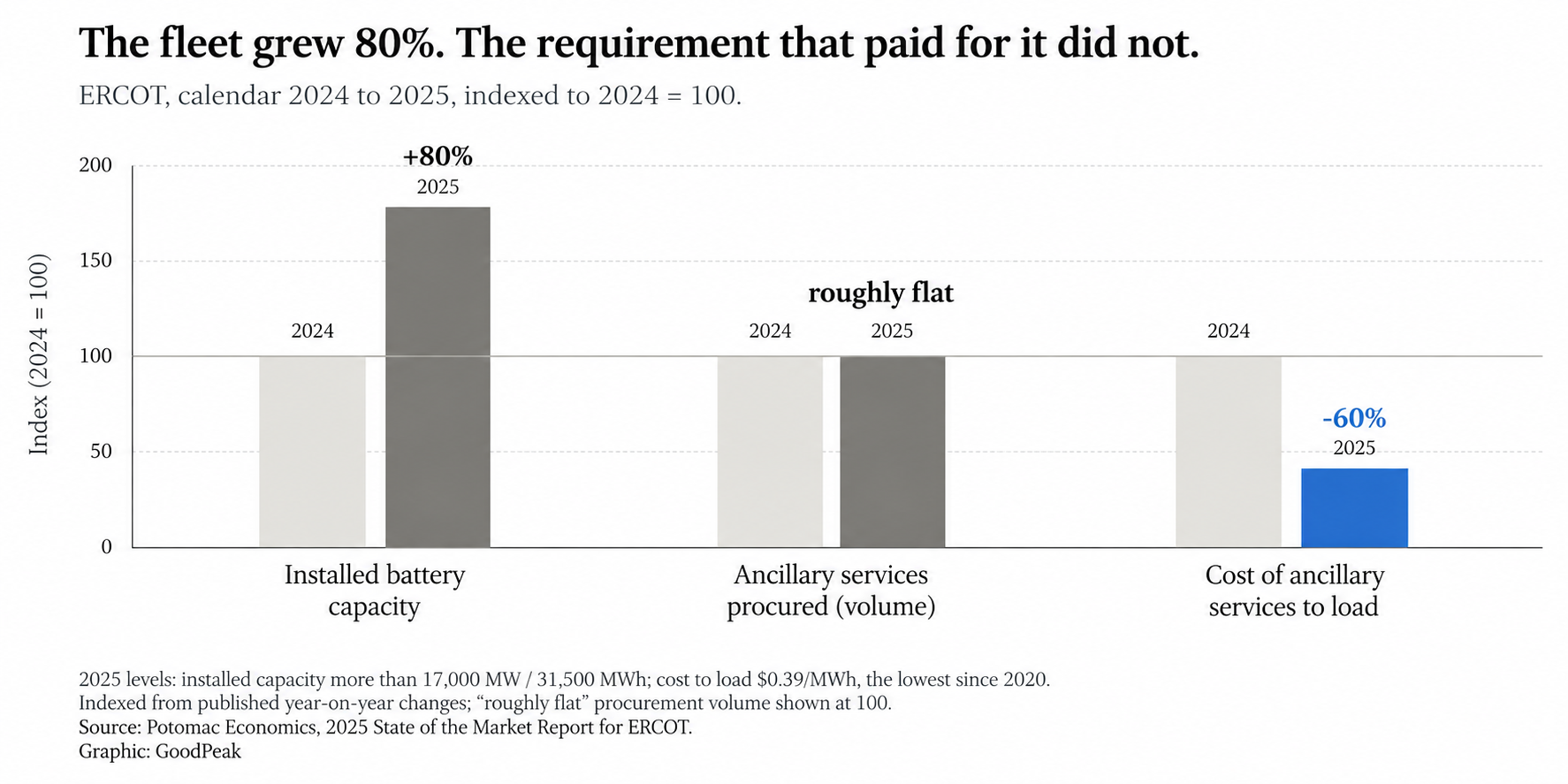
Three key data points from 2025 illustrate how Texas' electric grid operates. The number of megawatts in the battery fleet increased by almost 80%, reaching over 17,000 megawatts. The volume of ancillary services procured by ERCOT remained stable. The cost of these services to consumers dropped by 60%, to $0.39 per megawatt-hour, the lowest since 2020.
This situation, where battery supply nearly doubled, procurement stayed flat, and prices plummeted, is precisely as expected. However, the grid is projected to require more flexibility over the next decade. The revenue impact was immediate, with revenue per battery unit falling by 37% and ancillary services dropping to 28% of an average battery's revenue.
The average battery now earns about $30 per kilowatt over the past twelve months, roughly an eighth of its value two years prior. Despite the grid's larger size, the requirement for ancillary services is not set by demand but by statistical analysis of forecast error. The grid doesn't need twice the operating reserves for twice the size; it needs enough to cover potential forecast errors.
Despite procuring more operating reserves than any other US grid operator, the total requirement across all five products remains in the single-digit gigawatts. ERCOT's procurement practices may even require the requirement to be more than double the ancillary service quantities needed for reasonable reliability. Real-time co-optimization, introduced in December 2025, has changed how ancillary services are dispatched and priced but not the quantity procured.
Revenue streams from battery storage projects include ancillary services, intraday spread capture, and scarcity rent. Ancillary services have already saturated, intraday spread capture self-limits as storage arbitrages the gap between cheap and expensive hours, and scarcity rent depends on conditions rather than volume. The evolving revenue stack means projects now need to focus more on downside resilience alongside expected returns.
Written by urgent.news from HackerNoon's reporting — not their text. Machine-written — may contain errors; check the original before relying on it.