Chinese commercial reactor achieves nuclear fusion with clean hydrogen-boron fuel
In a first, a Chinese company has achieved high-parameter hydrogen-boron plasma control, marking a “significant and valuable” advance in research into neutron-free magnetic confinement fusion. ENN Group, based in Langfang, Hebei province, announced on Monday that its EXL-50U spherical device – a compact tokamak that uses a magnetic field to confine charged gas, or plasma, for nuclear fusion…
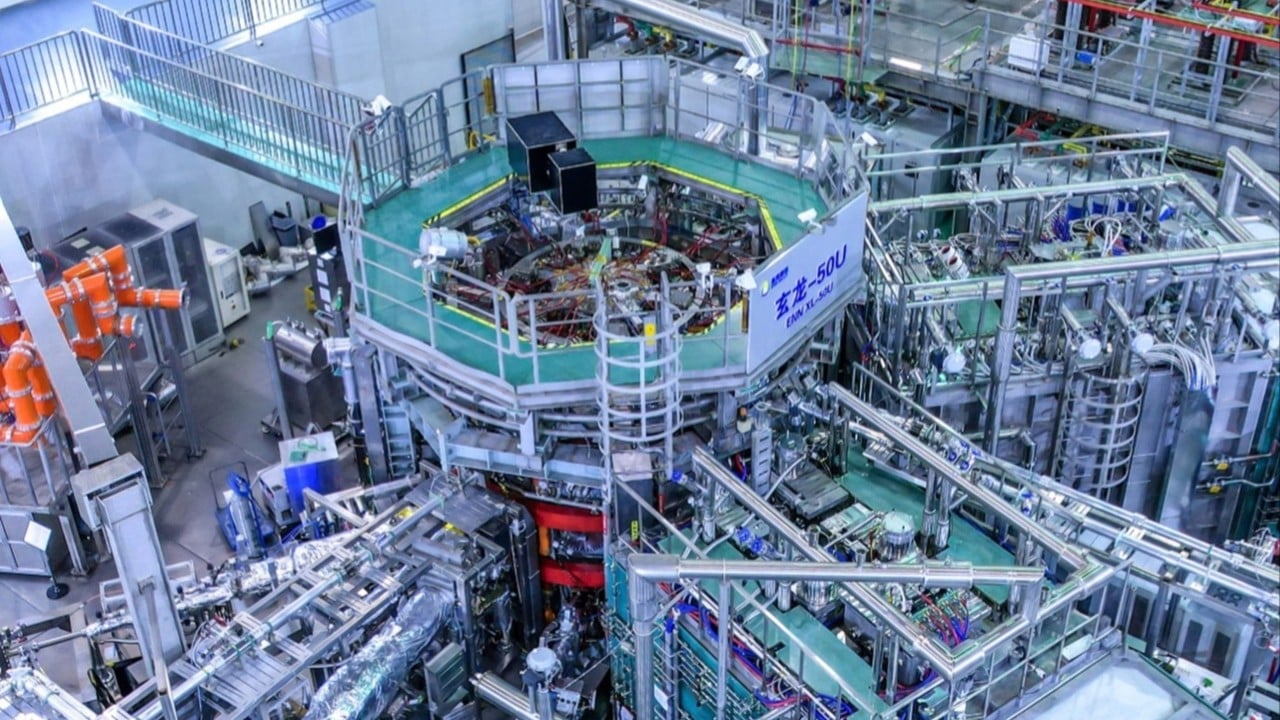
For the first time, a Chinese company has successfully achieved hydrogen-boron fusion reactions within its own spherical device, marking a significant advancement in the field of nuclear fusion research. ENN Group, based in Langfang, Hebei province, announced the accomplishment on Monday. The company's EXL-50U spherical tokamak, a compact magnetic confinement device that confines charged gas, or plasma, for nuclear fusion research, successfully generated hydrogen-boron fusion reactions.
This milestone comes as mainstream-controlled nuclear fusion research, represented by the International Thermonuclear Experimental Reactor (ITER) in France, primarily uses deuterium-tritium (D-T) as fuel. Tritium's rarity, scarcity, and radioactivity pose significant challenges to its use as a fuel source. In contrast, ENN Group has opted for a cleaner and more abundant fuel combination: hydrogen and boron-11.
The fusion process combines a hydrogen proton with a boron-11 nucleus, producing harmless helium nuclei and energy without releasing high-energy neutrons. While the reaction is highly demanding in terms of conditions and technical difficulty, ENN Group's team used high-energy neutral beam injection and radio frequency waves to target and stimulate the energy region where the fuel is most likely to react, known as the "first resonance peak."
This mechanism generated a large number of high-energy particles, acting as a catalyst for the reaction and pushing the fusion reaction rate beyond 100 million times per second.
More than 10 leading experts from international research institutes and renowned universities reviewed the experimental results, unanimously agreeing that the effective and repeatable measurement of alpha particles – the fusion reaction's product – substantiated the findings. The achievement, according to ENN Group, represents a significant and valuable contribution to global research on magnetic confinement hydrogen-boron reactions.
The company is part of a growing group of private Chinese companies and state-backed enterprises working towards building a commercial fusion reactor by 2035 or sooner. Earlier this month, ENN Group held a groundbreaking ceremony for the Helong-2 project at its fusion R&D center, a third-generation fusion device expected to serve as an important engineering platform in the pursuit of a smart fusion power plant.
Written by urgent.news from South China Morning Post's reporting — not their text. Machine-written — may contain errors; check the original before relying on it.