'Moer en soek' or 50-over? How T20 conditioned us out of loving ODI cricket
As franchise T20 leagues dominate calendars and attention spans shrink, One-Day Internationals struggle to maintain their relevance outside of World Cup years.
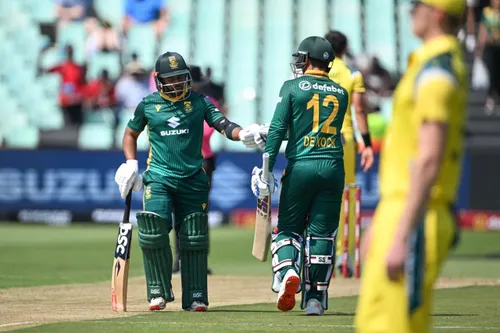
While watching the first ODI between South Africa and Australia in Durban, a thought occurred to me: we modern cricket fans might be unconsciously becoming disinterested in 50-over matches. Continuous exposure to T20 cricket, with new leagues and tournaments springing up regularly worldwide, seems to have desensitized us to the slower-paced ODI format.
During Thursday's game, South Africa's innings began sluggishly, allowing Australia to score six runs off the first three overs. Tony de Zorzi was dismissed without scoring, and Quinton de Kock made a modest 14 off 18 balls. Matthew Breetzke, however, played a crucial stabilizing role, scoring 112 off 106 balls and earning Player of the Match honors.
Marco Jansen's aggressive 75 off 59 deliveries, however, truly electrified the match. This experience made me realize that I instinctively favored Jansen's rapid scoring over the methodical, hard-fought 100-run innings of an ODI cricketer. This shift in perspective is starkly different from how we traditionally valued the game. International cricket started with Test matches in 1877, and it was not until 1971 that One-Day Internationals (ODIs) were introduced.
Although modern innovations like the Hong Kong Sixes and The Hundred have experimented with different formats, T20 has become the most lucrative financial enterprise in cricket. Currently, at least eight major T20 franchise leagues dominate the global schedule, led by the Indian Premier League (IPL). Locally, South Africa's SA20 is rapidly expanding as it prepares for its fifth season in January.
The career paths of established Proteas players like Quinton de Kock and David Miller underscore the challenge of preserving the unique character of ODI cricket. De Kock initially retired from ODIs after the 2023 World Cup to concentrate on global franchise opportunities, including the IPL, before returning last September—just two years before South Africa hosts the next ODI World Cup.
With over 7,000 runs in 162 ODIs, a player of De Kock's caliber seems to effortlessly rejoin the national team. Miller's situation is even more alarming. Despite having 179 ODI caps as a key middle-order batsman, he has played only four ODIs in the last two years, including this Australia match. In the same period, he amassed 22 IPL appearances and 15 outings in The Hundred.
The truth is clear: T20 leagues provide players with the most reliable financial stability, and they train their bodies and minds with this format in mind. Although Test cricket requires a different set of bowling tactics and unique batting techniques, ODI cricket shares significant tactical similarities with T20. Often, a T20 mindset can lead to successful outcomes in ODIs, even if certain match situations may call for more strategic caution.
Ultimately, the key difference lies in scale: an ODI consists of 100 overs compared to T20's 40 overs. This larger format naturally incorporates extended pauses—generally between overs 15 and 30—where teams can regroup, analyze conditions, or rebuild. T20, however, leaves no room for such breaks. This disparity clashes with evolving viewer habits.
Shorter attention spans are not inherent to cricket but rather a result of our digital generation accustomed to consuming content in rapid, short-form snippets, devoting only seven to ten seconds of focus to any given topic. It is in this context that sports administrators confront an uphill challenge. When trying to attract new audiences to cricket, justifying the leisurely pace of an ordinary ODI series is becoming increasingly difficult, except perhaps during World Cup tournaments.
Written by urgent.news from IOL's reporting — not their text. Machine-written — may contain errors; check the original before relying on it.