JWST Finds Dynamic Structural Evolution in Chariklo’s Rings
When we think of asteroids, we often think of the main asteroid belt between Mars and Jupiter that contains the majority of the known asteroids in our solar system. However, our solar system hosts several other populations of asteroids and icy rocks, including the Jupiter Trojan asteroids that orbit in Jupiter’s orbit, and the icy bodies and comets of the Kuiper Belt. But there’s one population…
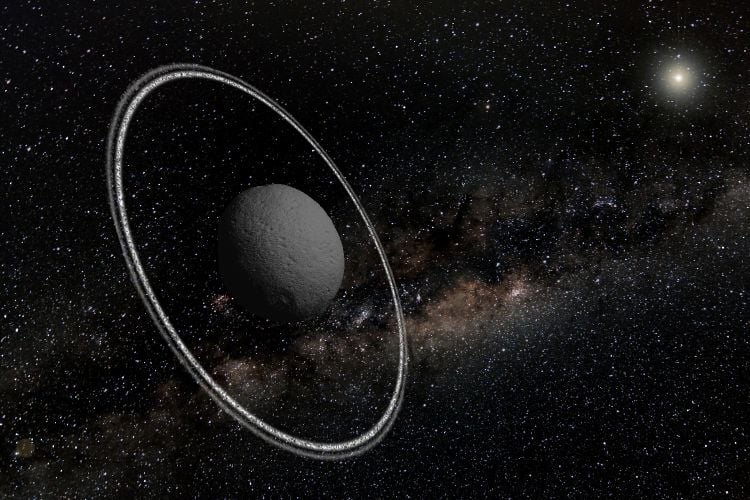
A new study published in Science Advances reveals that the rings of the asteroid Chariklo are undergoing a dynamic evolution, with its inner ring becoming denser by more than 50 percent and its outer ring becoming 60 percent less opaque compared to a previous study from 2017. Chariklo, the largest known Centaur with a radius of 125 kilometers, is the only Centaur to possess a ring system, which was initially discovered in 1997 and confirmed in 2013.
The research team utilized stellar occultation, a technique that involves observing a star's light dip as it passes behind an object, to study Chariklo's rings using ground-based telescopes and NASA's James Webb Space Telescope (JWST) in 2022. The findings suggest that Chariklo's rings are not static and are likely experiencing changes in material composition, either due to temporal evolution or wavelength-dependent opacity.
This discovery highlights the potential of JWST to unlock new insights into the physics governing ring systems around minor bodies in our solar system, and future studies may shed further light on this intriguing phenomenon.
Written by urgent.news from Universe Today's reporting — not their text. Machine-written — may contain errors; check the original before relying on it.