Gibt es außerirdisches Leben?: Saturn-Mond: Bedingungen für Leben günstiger als angenommen
Der Eismond Enceladus ist einer der wenigen Orte in unserem Sonnensystem, dessen Bedingungen die Entstehung von Leben zulassen. Die Ergebnisse einer neuen Studie verblüfft die Forscher.
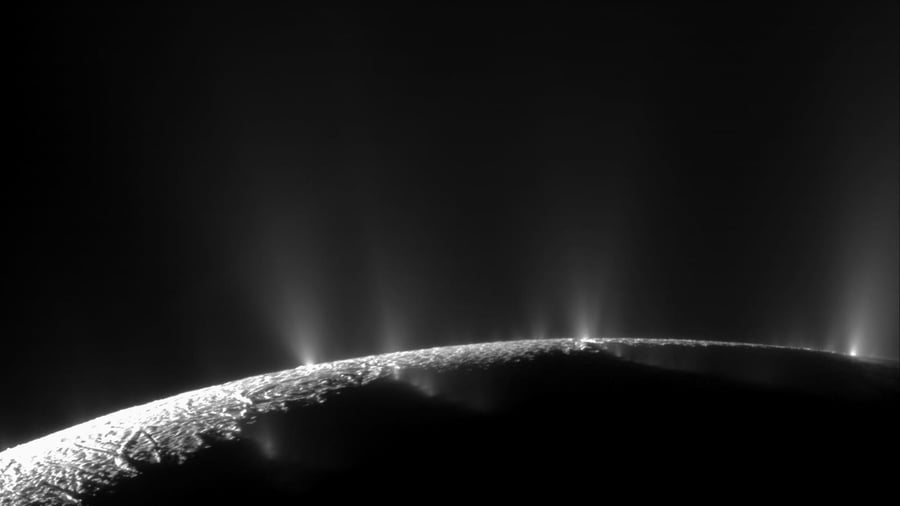
Saturn's icy moon Enceladus might be more hospitable to life than previously thought, according to a new study by researchers from the Ludwig-Maximilians-Universität München (LMU), the University of Regensburg, and the Free University of Berlin. The study, published in the journal Science Advances, found that certain microorganisms, specifically archaea, could survive in the moon's underground ocean and rocky seabed despite its harsh conditions.
Lead author Vanessa Helmbrecht explained that Enceladus is considered one of the most promising locations for the search for extraterrestrial life, as it has a unique geochemistry that could create conditions more favorable for microbial life than previously assumed. The researchers replicated the moon's seafloor conditions in the lab, including a low oxygen environment, the alkaline ocean, and the rocky seabed, and introduced a microorganism called Methanothermococcus okinawensis, which thrives in deep-sea environments on Earth.
The results showed that the archaeon not only survived but also produced methane using hydrogen, which is generated through water-rock reactions. This discovery challenges the notion that such extreme conditions would be lethal to anaerobic, single-celled organisms. While the study does not prove the existence of life on Enceladus, it does suggest that essential geochemical features could potentially support the oldest forms of life.
Further exploration of Enceladus will continue with the European Space Agency's planned mission "L4" in 2042, which aims to collect samples from the moon's geysers to search for signs of microbial life.
Written by urgent.news from Handelsblatt's reporting — not their text. Machine-written — may contain errors; check the original before relying on it.