Urgent.News

What's breaking now, across thousands of outlets.

AI

AI camera mistakes guitar for pillion rider in Bengaluru, issues fine for not wearing helmet

After getting a ₹500 challan, the rider complains to the Bengaluru Traffic Police and seeks rectification; the incident draws attention to the limitations of AI-dependent traffic systems; AI sharpens with more data, says a senior official
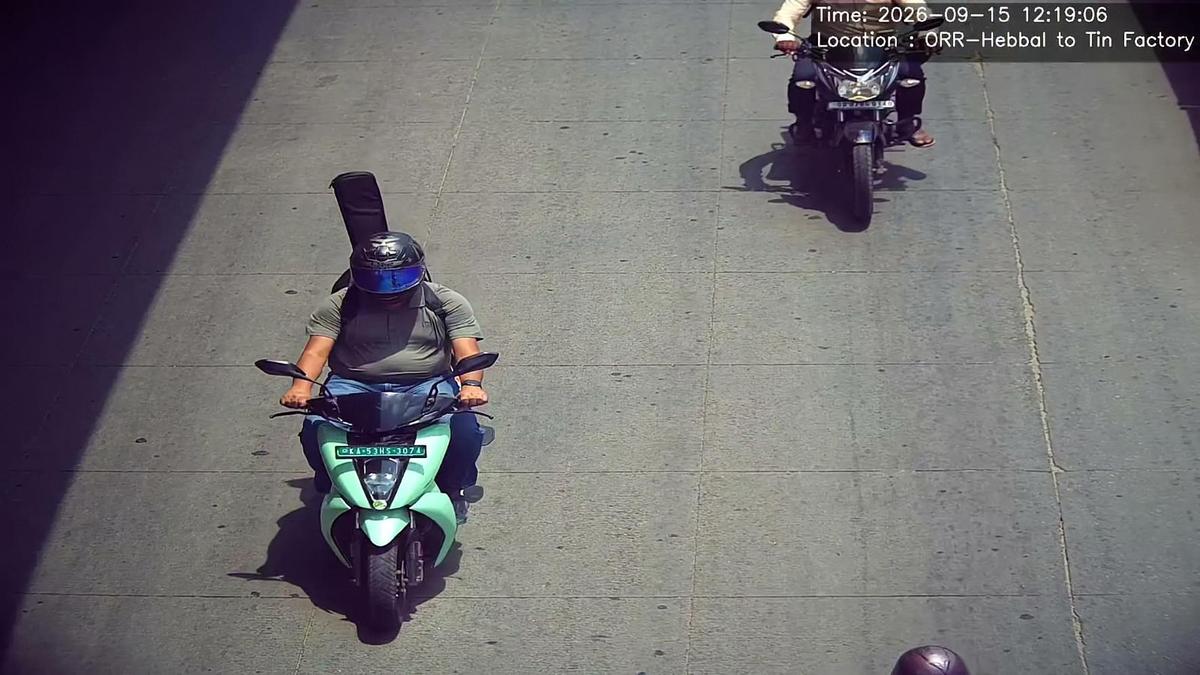
AI camera mistakes guitar for pillion rider in Bengaluru, issues fine for not wearing helmet

An AI-powered traffic camera in Bengaluru issued a fine to a guitar case slung on its owner's back, mistaking it for a pillion rider without a helmet. Souvik Dutta was on his scooter from Hebbal towards Tin Factory with the guitar case when the AI camera spotted it and sent a challan to his wife, citing the violation. Dutta complained to the Bengaluru Traffic Police (BTP), which then directed him to contact the traffic automation section for rectification.

The incident highlights the limitations of automated traffic enforcement systems, with many motorists expressing concerns over false violations for minor infractions. A senior traffic police officer confirmed that the pillion rider violation was a false flag caused by an AI system error, which can happen occasionally. The officer also mentioned that the system would improve with continuous data feeding, but admitted that it has not yet achieved 100% accuracy.

Written by urgent.news from The Hindu's reporting — not their text. Machine-written — may contain errors; check the original before relying on it.


Read the original at thehindu.com →

More in AI

AI Finds So Many Linux Bugs, Canonical Changes to a Two-Week Stable Release Update Cycle

"Finding vulnerabilities faster also puts pressure on Linux distributions to fix and deliver patches faster," writes Slashdot reader BrianFagioli AI has transformed bug discovery from "a manual…

  • AI accelerates Linux bug discovery, leading to a surge in CVEs.
  • Canonical adopts a two-week stable release update cycle to address rapid vulnerability fixes.
  • Users receive safe workarounds and hardening steps until patches are released.

The Self-Regulatory Moat

When three direct commercial competitors agree to establish an independent oversight body, the financial press usually frames it as responsible stewardship or an eleventh-hour attempt to stave off…

  • Google, OpenAI, and Anthropic form Standards Authority for Frontier AI (SAFA).
  • SAFA aims to standardize benchmarks, pre-deployment reviews, and incident disclosure.

Self-Replicating Prompt Injections Turn Agent Context into an Open Relay

Most developers still treat prompt injection as a leakage problem. Someone types an adversarial string into your support bot, confuses the instruction hierarchy, and tricks the model into leaking an…

  • Self-replicating prompt injections possible in autonomous agents
  • GPT-Red framework used to demonstrate vulnerability
  • Four mitigation strategies recommended to prevent spread

What an Over-Engineered Parity Classifier Taught Me About Representation

I Revisited My Parity Paper — and Found the Representation Was the Real Story A while ago, I built a deliberately over-engineered classifier for one of the easiest problems in computer science: Is an…

  • Over-engineered parity classifier achieved 84.26% test accuracy with stricter evaluation protocol
  • Masking least significant bit reduced validation accuracy to random guessing (48.15%)
  • Representation-dependent structure in wavelet transform crucial for parity recovery

More from Saturday 26 September →