The AI Code Avalanche: Building an Adversarial Pipeline to Stop Code Hallucinations Before They Hit
Drowning in AI-generated PRs? Learn how to build a multi-agent adversarial pipeline to catch code hallucinations and enforce architecture before it hits main.
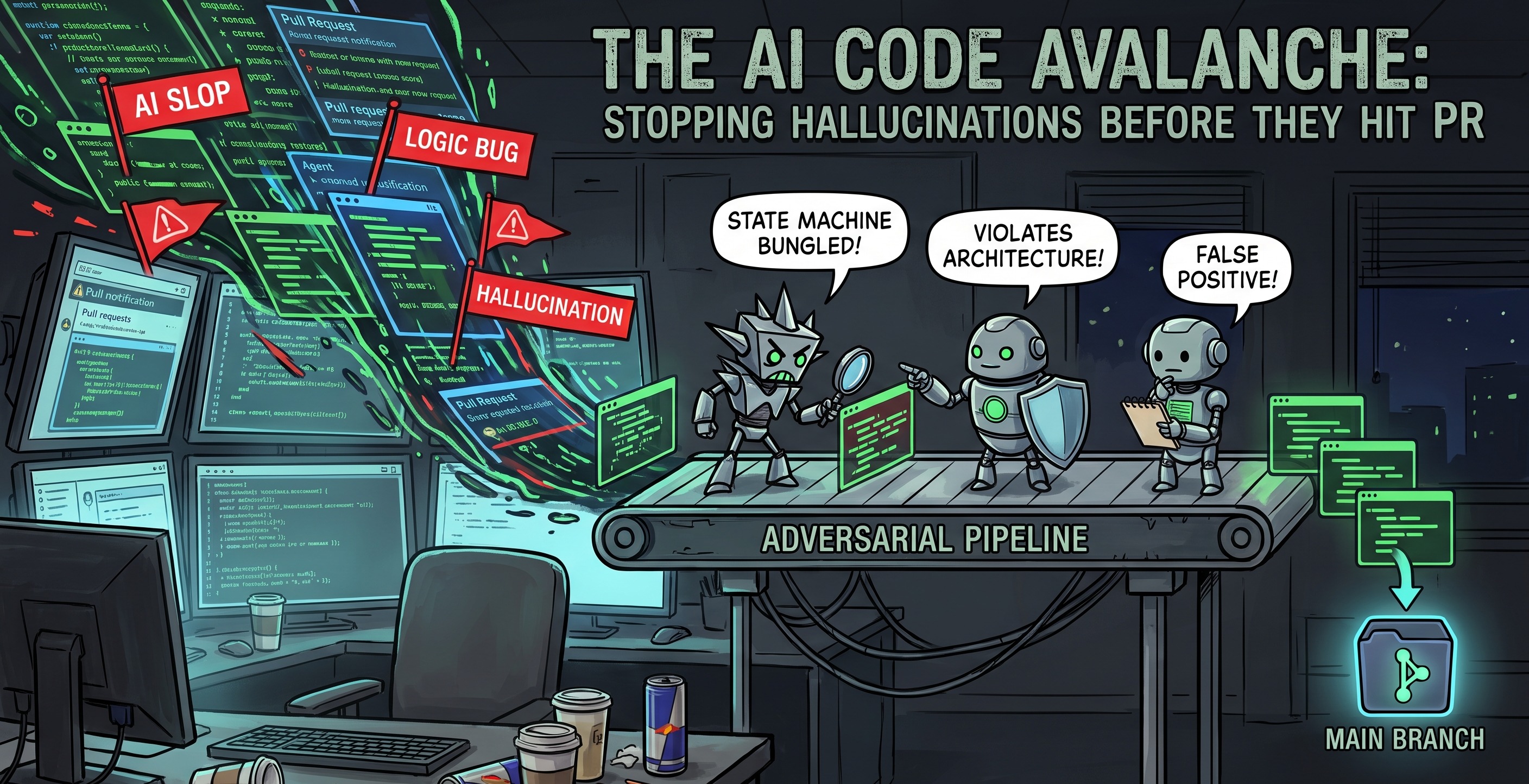
In the rapidly evolving world of AI-powered software development, a new pipeline has emerged to combat the issue of "code hallucinations" – AI-generated code that appears correct but contains subtle flaws. Senior engineers are overwhelmed with pull requests filled with AI-generated code that passes traditional checks but still violates architectural rules and module boundaries. To address this, a senior engineer built an adversarial pipeline that catches these issues before they reach the repository.
Phase 1 focuses on shifting the focus left, shielding the local environment, and enforcing strict architectural boundaries. This is achieved through .cursorrules and claude.md files, which provide architectural context to local coding agents. However, to enforce these rules, custom bash hooks are used to intercept the edit and commit phases.
These scripts dynamically inject guidelines and run deterministic checks before the code is committed to the repository. The example provided demonstrates a pre-commit hook that intercepts AI-generated code to ensure UI components do not directly import database clients. If a violation is detected, the hook prints an error message and exits with a non-zero status, preventing the code from being committed.
Phase 2 introduces a judicial system for code review. Before a developer opens a pull request, a multi-agent adversarial review is triggered locally. This system consists of specialized agents working together to catch logic bugs, untested states, and convention violations. The Prosecutors (Finders) scan the entire diff for potential issues and output structured JSON payloads detailing their findings.
The Defense (Refuters) agents attempt to disprove the Finders' claims, while the Detective (Completeness Critic) agent searches for edge cases that may have been missed. These agents do not modify the codebase but instead provide a high-signal report to the human developer, who retains final execution authority.
Phase 3 involves the CI Fast-Track, which runs once the code actually reaches the continuous integration (CI) pipeline. Due to the high cost and slow nature of running a multi-agent debate inside GitHub Actions for massive PRs, a different strategy is employed. Once the code hits CI, parallel job sharding and lightweight models with narrow instruction sets are used for focused PR validation.
This final safety net serves to catch any remaining issues without clogging up the deployment pipeline. The workflow demonstrates how to split the git diff into isolated chunks and run smaller, faster models in parallel using GitHub Actions.
Written by urgent.news from HackerNoon's reporting — not their text. Machine-written — may contain errors; check the original before relying on it.