Scratching the surface: A field guide to 100 essential novels
If you’re not a member, then probably someone you know or love is: that shrinking, but still substantial guild of book-balancers who build towers of paperbacks on their nightstands. Few things are as enjoyable as finishing a good book, except perhaps starting a new one, and because the latter is easier than the former, the job is never done. Hence that precipitously perched tower of books. Being…
For those who aren’t avid readers, it’s likely that someone close to you falls into this category: a small but persistent group of individuals who curate stacks of novels on their nightstands. The sheer joy of finishing a captivating book is only topped by beginning a new one, making the perpetual reading list an ongoing pursuit.
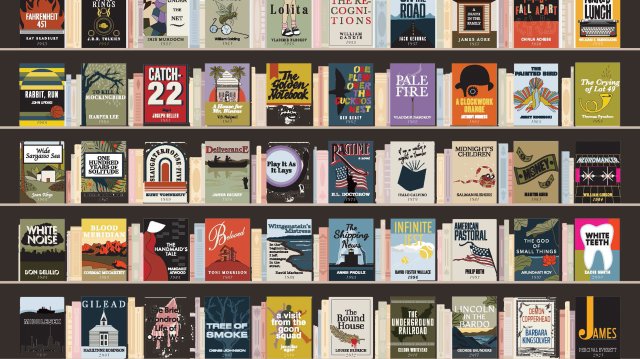
This desire to read intensifies the ever-present challenge of finishing a book. Introducing a new poster aims to alleviate this frustration by offering a finite list, infused with the gamification of the digital age. The poster presents a scratch-off chart featuring 100 Essential Novels, with hand-drawn book covers hidden beneath a layer of foil.
As you read a book and scratch the foil, the corresponding novel’s cover materializes – Gatsby’s eyes emerge from the metallic haze or Ahab’s white whale dives in all its glory. This poster transcends a mere reading list, acting as both a progress bar and wall art that provides a dopamine boost. However, the question remains: what specific itch does this poster aim to scratch?
Before reaching for the scratching coin, let’s scrutinize the selection process more closely. These 100 novels represent an opinionated cross-section of over four centuries of high literature. They explore profound themes through beautiful language and are presented chronologically, from Don Quixote (1605) at the top left to James (2024) at the bottom right.
Nevertheless, such a qualitative selection is bound to be debated. The poster leans heavily towards the Anglosphere, with just five works originally written in other languages – two in Russian, two in Spanish, and one in German. Approximately 60% of the works come from the U.S., while the majority of the remaining books hail from the U.K. or Ireland.
Only one in four of the works is penned by women, and 16 of the 100 books were published in the 1950s – a larger percentage than the entirety of the 21st century so far. Furthermore, Ulysses (1922) is notably absent from the list. While James Joyce’s A Portrait of the Artist as a Young Man (1916) is included, Ulysses, widely regarded as the 20th century’s best novel, is not.
This omission raises an interesting question: can a novel be considered essential if it’s exceptionally challenging to read? The poster suggests not, with confidence. However, when cross-referencing these books with other best-of rankings, a stable core emerges, featuring undisputed classics such as The Great Gatsby (1925), Mrs. Dalloway (1925), 1984 (1949), Lolita (1955), One Hundred Years of Solitude (1967), and Beloved (1987).
Around this core, which has remained consistent throughout decades and editorial trends, the lists diverge wildly. The poster includes The Lord of the Rings (1954-1955) and The Lion, the Witch and the Wardrobe (1950), while many "serious" lists omit these titles. This discrepancy highlights an intriguing inquiry: do rankings compiled by critics during a specific decade represent absolute literary greatness, fleeting fashion trends, or personal preferences?
The answer is undoubtedly a combination of all these factors. Despite the imperfection of such lists, arguments surrounding them serve a purpose. They foster discussion, debate, and excitement. After all, great literature merits the spark of argument. Nonetheless, the ultimate purpose of these lists is to inspire readers to pick up a book.
Upon closer inspection, I find myself surrounded by unread books, a phenomenon known as tsundoku in Japanese. The poster presents a feasible challenge to close this gap between the number of books I adore buying and those I manage to read. Although some titles on the list may seem daunting due to their age and length, such as Don Quixote (1605) and Middlemarch (1872), cracking open these works reveals a modern sitcom protagonist – a retired man in second-hand armor and his skeptical companion, navigating slapstick disasters one after another.
The poster assures that even the most challenging classics can be conquered. However, not all classics are as challenging. The very first book on the list, Don Quixote, has a reputation issue stemming from its age and length, but it is widely acknowledged for its comedic value. Conquering Cervantes or tackling the 800-odd pages of Middlemarch may be arduous, especially in our era of short-form content.
Yet, recent studies indicate that Americans who read for pleasure have decreased by nearly half since the early 2000s. Despite this trend, those who continue reading are now devoting more time to literature than ever before. The satisfaction of reading literature extends beyond mere intellectual engagement; it also carries a metatextual aspect, as exemplified by the conversation spanning 140 years between two works of American literature featured on the poster – Adventures of Huckleberry Finn (1884) by Mark Twain and another title.
Written by urgent.news from Big Think's reporting — not their text. Machine-written — may contain errors; check the original before relying on it.