S-Shaped Utility Curves, Poverty, and Risk-Taking
When economists think about how much utility is gained from additional economic resources the basic assumption is that an additional amount of income or wealth increases utility, but by a diminishing amount–because additional income or wealth has diminishing marginal returns. However, there’s also a long-standing tradition in economics of thinking about why this relationship might … Continue…
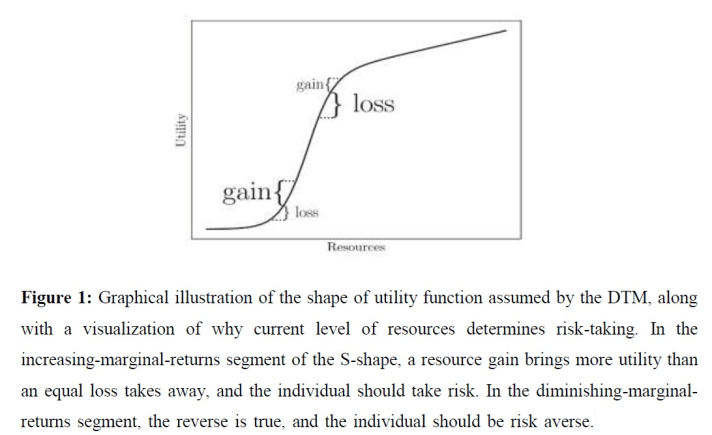
The article "Explaining the paradoxical effects of poverty on risk taking: The Desperation Threshold Model" by Benoît de Courson, Willem E. Frankenhuis, and Daniel Nettle explores why individuals with low income may be more inclined to engage in risky behaviors, such as crime or gambling. The authors propose an S-shaped utility curve to illustrate this phenomenon, where an individual's willingness to take risks depends on their proximity to a basic level of resources required for survival.
In the upper-right portion of the curve, additional income or wealth leads to an increase in utility, but the marginal gains diminish, causing the curve to flatten out. This means that a person considering a risky choice that could result in a gain or loss of an equal amount of income will only make this decision if the probability of gain is sufficiently high, typically greater than 50:50.
However, in the lower-left portion of the curve, the assumption is that people need a basic level of resources to survive. For those who have resources substantially below this level, additional income does not increase their utility because their survival needs are still not met. Nevertheless, if a person is just below this basic survival level and considers a risky choice that could gain or lose an equivalent amount, the utility loss from this choice is relatively low.
This is because being further below the basic survival level has a minimal impact on their overall utility. Conversely, if a risky choice can elevate this person to a position above the basic survival level, the marginal utility gains become substantial, making them more inclined to take risks.
The authors emphasize that this "mid-level theory" is not meant to assert that all people behave in a certain manner, but rather to provide a basis for further discussion and insights into real-world situations. They acknowledge that the theory raises numerous questions regarding its explanatory scope, cognitive and neural implementation, and applicability across different socioecological contexts and scales.
One notable question is how people's perception of the basic level of resources may vary depending on their socioeconomic status and cultural context. For instance, middle-class individuals or those with above-average wealth may not consider themselves to have the "basic" resources that others perceive as such. Additionally, the model suggests that individuals just above the "basic" level may be more risk-averse, while those just below it may be more prone to taking risks.
Written by urgent.news from Conversable Economist's reporting — not their text. Machine-written — may contain errors; check the original before relying on it.