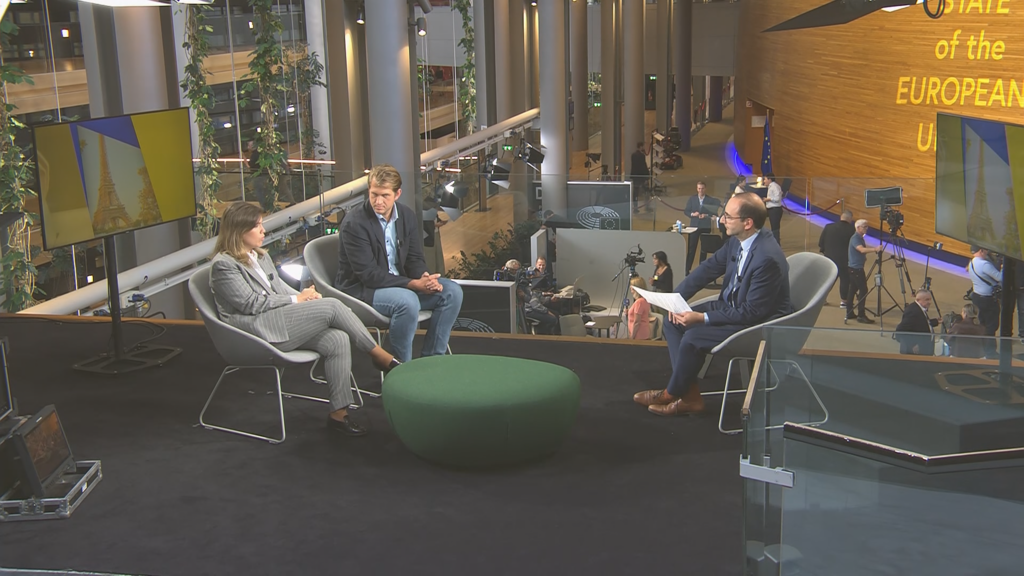
'Lithuanian skies are NATO skies': DW interview with Lithuania’s prime minister Mindaugas Sinkevicius
In a DW interview, Prime Minister Mindaugas Sinkevicius discusses threats to Lithuania from Russia and Belarus, NATO’s need for stronger air defense and why military spending alone cannot ensure security.
Lithuania sits on the eastern edge of NATO, sharing borders with Belarus and Russia's Kaliningrad region. Following Russia's full-scale invasion of Ukraine, national security has become a top political priority for the nation. Prime Minister Mindaugas Sinkevicius, who assumed leadership of Lithuania's Social Democratic Party just weeks ago, spoke about these matters in an exclusive interview with DW.
The prime minister expressed concern over the rise of populist and far-right parties across Europe, particularly in Western Europe. However, he noted that the situation is more complex, citing examples of Social Democratic governments in several European countries and growing support for the center-left elsewhere.
Lithuania's security issues are closely tied to the ongoing war in Ukraine. The country has faced multiple incidents involving drones, migrants manipulated for political purposes, and weather balloons entering its territory from Belarus. These events have heightened a sense of insecurity throughout Europe. Sinkevicius emphasized that politicians must be honest with their citizens about the threats they face.
He identified air defense as the most pressing security priority for Lithuania. Given that Lithuania's airspace is shared with NATO, the prime minister stressed that if Lithuania's skies are secure, the broader NATO airspace is largely protected as well. He called for greater solidarity among NATO allies, noting that the threat extends beyond Lithuania's borders, affecting other European nations too.
While NATO membership provides a collective defense framework, Sinkevicius stressed that individual countries must also contribute to their own security. This includes strengthening their own deterrence capabilities alongside continued collaboration with NATO and regional partnerships. The prime minister advocated for a balanced approach, acknowledging the importance of both traditional military equipment and newer technologies like drones.
Sinkevicius rejected the notion that European nations should choose between conventional military hardware and advanced technologies. He argued that both are necessary for comprehensive defense. More importantly, he emphasized that military equipment alone cannot guarantee safety; societal well-being and people's connection to the state are equally crucial.
The prime minister views social policy as an integral part of national security. A strong state should support vulnerable citizens, such as the unemployed, the ill, and others in need. This perspective reflects the evolving priorities of center-left governments in Europe, who are now prioritizing national security alongside traditional social democratic principles.
Recently, Sinkevicius visited Ukraine, meeting with political leaders in Lutsk and Kyiv. Lithuania has pledged to allocate at least 0.25% of its GDP annually to support Ukraine, which currently amounts to around 0.3% of GDP. The prime minister acknowledged a growing sense of war fatigue in Europe but urged societies to consider the hardships faced by Ukrainians.
He highlighted the crucial role of Western European countries, particularly Germany, in maintaining support for Ukraine, emphasizing that continued assistance is essential to prevent the failure of the eastern front.
Written by urgent.news from DW News's reporting — not their text. Machine-written — may contain errors; check the original before relying on it.