Fly neurons carry molecular signatures of their origins
The pattern of transcription factors a Drosophila neuron expresses offers clues to its lineage and birth order—and ultimately how neural circuits emerge.
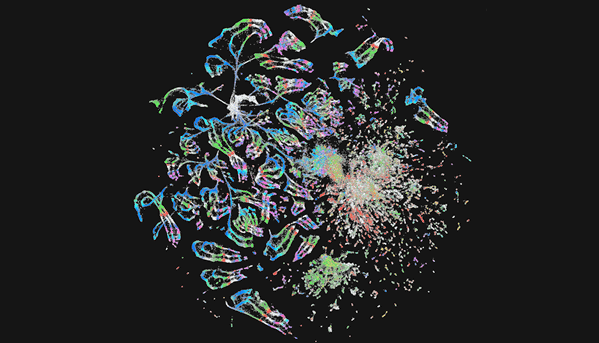
Two new studies of Drosophila melanogaster, published in Nature, reveal that a fruit fly's nervous system generates its diverse neurons through a molecular code that tracks two key aspects of a neuron's identity: lineage and birth order. This research, led by Josie Clowney and Erika Donà, respectively, sheds light on how neural circuits emerge during development.
Drosophila is an ideal model organism for this study due to the highly stereotyped nature of its nervous system, where identical neurons can be found in the same locations across all fruit flies.
Single-cell RNA sequencing in the first study identified 89 transcription factors expressed in complex combinations that distinguished neuron families, or "hemilineages," each descending from a single stem cell and sharing the same developmental fate based on the NOTCH gene's activity. The second study, which mapped the ventral nerve cord, identified 34 cord hemilineages and 17 transcription factors that encode neuronal birth order.
Both studies suggest that a neuron's molecular code extends into adulthood, potentially helping maintain its identity. These findings offer a layered model of neuronal identity, with a hemilineage-specific gene-expression code establishing a neuron's broad family and anatomical plan, and a birth-order code generating different subtypes within that family.
These discoveries could ultimately reveal how developmental genes guide the wiring of neural circuits, though the existence of a similar systematic code in vertebrates remains unclear.
Written by urgent.news from The Transmitter's reporting — not their text. Machine-written — may contain errors; check the original before relying on it.