Debt trap looms large over A.P. weavers
The weaving sector once sustained by handloom cooperative societies across Andhra Pradesh is currently reeling under mounting dues, dwindling orders and disappearing livelihoods, Nellore Sravani reports, as many societies are becoming dormant due to non-payment of dues on the part of the State government
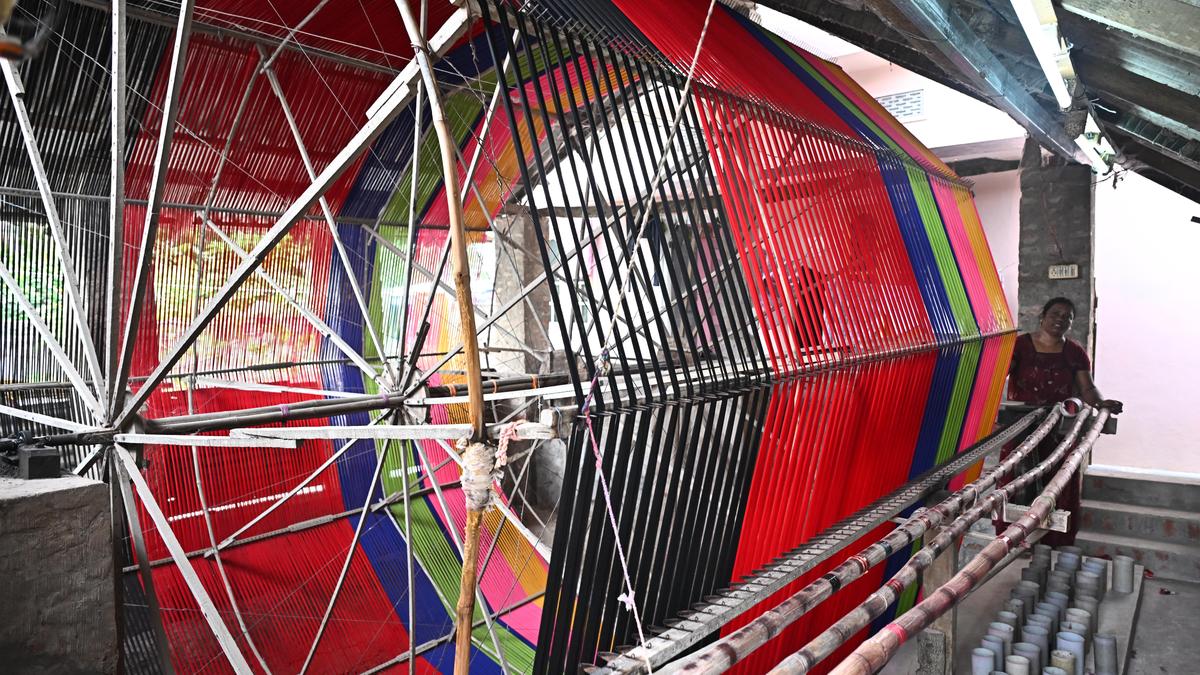
In the village of Angara, a sleepy hamlet in Dr. B.R. Ambedkar Konaseema district, the weavers at Balla Koteswara Rao and Balla Janaki's modest workshop have already begun their laborious day at 6 a.m. Koteswara Rao, a senile couple, toils over 13 hours to weave a single saree, barely managing to earn ₹250 or ₹300 after expenses. Despite their efforts, delayed payments from the Andhra Pradesh State Handloom Weavers' Co-operative Society Ltd. (APCO) have left them dependent on their daily wage.
The handloom weaving sector in Andhra Pradesh, once buoyed by cooperative societies across East and West Godavari and B.R. Ambedkar Konaseema districts, is now grappling with mounting dues, dwindling orders, and a dwindling workforce. The state government owes ₹265.09 crore, an outstanding amount from 2016, to APCO and handloom societies.
Andhra Pradesh, a major hub for handloom weaving in the country, is known for its cotton and silk products such as Ponduru, Uppada, Pedana, Mangalagiri, Venkatagiri, Dharmavaram, Chirala, and Madanapalle. The 4th All India Handloom Census 2019-2020 revealed that the state has 1,27,662 weavers and 49,785 allied workers. However, the number of active cooperative societies has dwindled to 200, down from 415, according to the Department of Handlooms.
The cooperative societies were formed to protect the welfare of traditional artisans and provide a stable livelihood. They supplied raw materials, marketed products, and ensured fair wages. However, the lack of timely government payments and removal of subsidies on raw materials, like yarn, have led to the collapse of many cooperative societies, particularly in Polavaram district. Only 215 weavers remain active in the Polavaram Weavers' Cooperative Production and Sale Society Ltd., down from around 700 families in 2011.
The fall of the cooperative societies is attributed to the cessation of payments by the government under schemes like 'Paavala Vaddi' and Thrift Fund, as well as subsidies on raw materials. The weavers are left with no choice but to work under master weavers or take up other professions, often for less pay and more laborious work.
Written by urgent.news from The Hindu's reporting — not their text. Machine-written — may contain errors; check the original before relying on it.