12 years of ‘Make in India’ in 12 metrics — Low and patchy impact on growth, employment & global share
While recent incentive schemes by the government have seen some success, those gains are limited to a handful of sectors
Twelve years after the inception of the Make in India campaign on September 25, 2014, an examination of 12 metrics related to growth, investment, employment, and exports reveals that the manufacturing sector's contribution to India's economic growth, employment, and global exports has remained largely unchanged. While recent government incentive schemes have yielded some success, gains are chiefly limited to a select few sectors.
Prime Minister Narendra Modi launched the campaign, emphasizing that industrialists seek a "development and growth-oriented environment" rather than mere incentive schemes. The data over the past 12 years indicates that while incentive schemes have been successful, other factors reflecting a "development and growth-oriented environment" have underperformed.
The manufacturing sector has grown faster than the overall economy in five out of the 12 years, but this trend is slowing down, with the gap narrowing fast. The Index of Industrial Production reveals that the manufacturing sector outpaced overall growth in only three of the 12 years, with the new series showing the sector's growth matching the overall index for 2023-24 and lagging slightly in the subsequent two years.
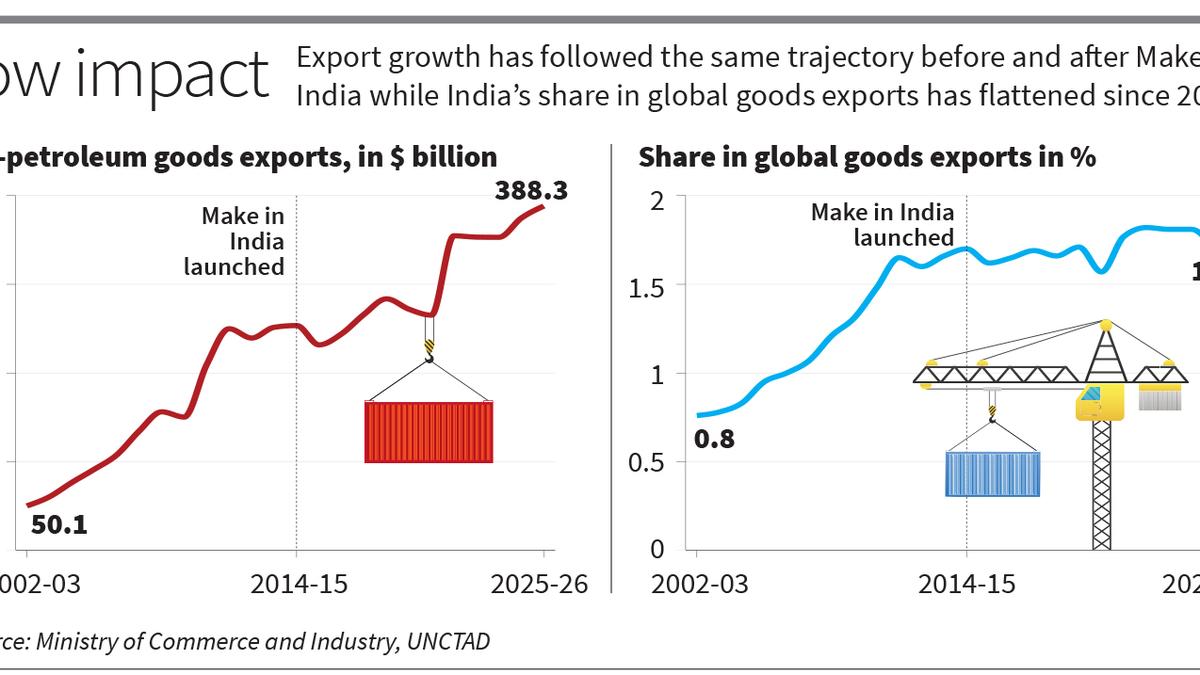
The manufacturing sector's share in overall Gross Value Added (GVA) has decreased from 14.6% in 2022-23 to 15.6% in 2025-26 in the older series, while it has marginally increased to 15.6% in the newer series. India's non-petroleum goods exports grew 53% to $388.3 billion in 2025-26 from $253.5 billion in 2014, but the base effect explains a significant portion of this growth disparity.
India's share in global merchandise exports has been relatively stagnant at around 1.7% since 2013. Private sector gross fixed capital formation (GFCF) as a percentage of GDP has been declining since 2022-23. Foreign Direct Investment (FDI) in the manufacturing sector grew from nearly 48% in 2014-15 to 55% in 2025-26. RBI's data on capacity utilization shows that it has never consistently increased and remains below the 80% threshold, suggesting that banks are extending loans primarily for working capital rather than fresh investments.
Government Production-Linked Incentive schemes have generated Rs 2.4 lakh crore in cumulative investment as of March 2026, but this success is heavily concentrated in five sectors, accounting for 83% of the investment. These sectors also contribute to more than 86% of the 8.5 lakh people employed under these schemes. The manufacturing sector's employment share remained stable at around 5.3 crore as per the latest data.
Written by urgent.news from The Hindu's reporting — not their text. Machine-written — may contain errors; check the original before relying on it.