Why is Trump rolling out the red carpet for China's Xi?
US President Donald Trump will host Chinese leader Xi Jinping at the White House on Thursday for a day full of pageantry. Trump personally greeted Xi on the tarmac after his arrival on Wednesday, the first time in more than six decades that a US president has welcomed a foreign political leader at Joint Base Andrews near Washington. But Trump's decision to roll out the red carpet has ruffled…
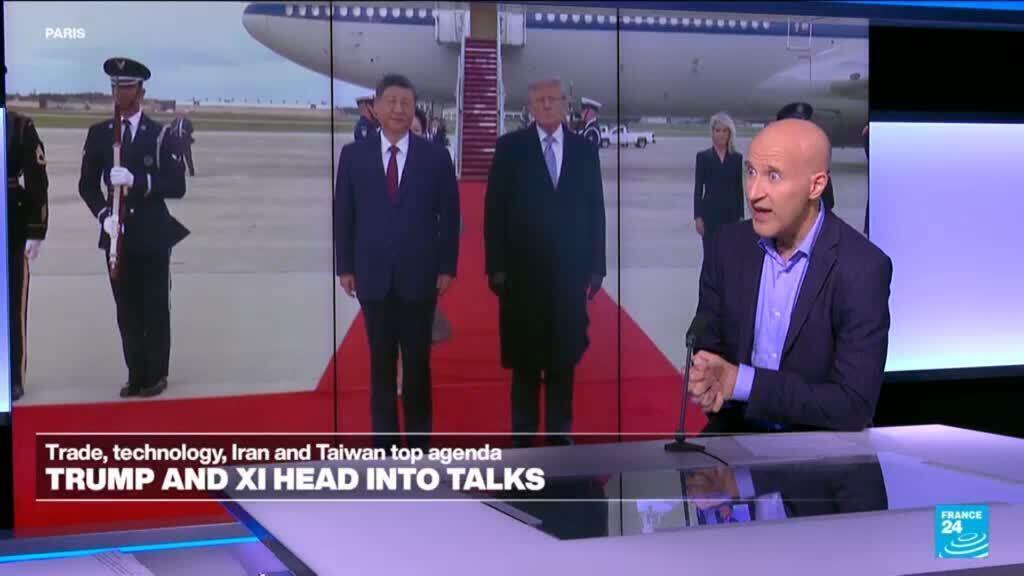
While President Trump and Chinese President Xi Jinping met in Washington to discuss principles surrounding artificial intelligence (AI), China and the United States remain divided over how open AI should be. Chinese AI models can be downloaded and adapted, while OpenAI and Anthropic keep their models closed. This difference in approach is likely to be a topic of discussion at the summit.
As AI technology advances rapidly, experts warn that it could surpass human control and call for slower development and regulations. However, these regulations are only effective if both superpowers adhere to them.
The US President downplayed the concerns of AI researchers, stating that they want to maintain their lead over China in the race for the strongest AI. Dario Amodei, the head of Anthropic, argued that the US should only slow down as much as necessary to maintain this lead, suggesting specific measures like export restrictions on high-performance chips. China's response was negative, with a spokesperson saying that panic, confrontation, and unyielding competition would only hinder global AI governance.
The competition between the US and China is becoming increasingly rigid, with each following different strategies. While Anthropic and OpenAI keep their strongest models closed and selectively share progress, Chinese AI companies openly publish the parameters of their models online, allowing anyone to download and run them on personal computers or servers.
This practice puts American AI firms at a disadvantage. The question arises: is it safer to keep AI models closed with a few companies or make them freely downloadable online?
Open AI models are classified based on their level of openness, with open-weight models only disclosing the parameters that determine the model's function, while open-source models allow access to training data and code. Most Chinese AI models are open-weight, keeping their training data secret, which often includes political views of the Chinese state.
Despite this, Chinese AI models are increasingly popular. Data from the Open Router platform, used by corporate customers, shows that eight out of the ten most-used open AI models are Chinese. Chinese models are also frequently downloaded from Hugging Face. Many US and European companies, including Airbnb and Coinbase, have started using Chinese AI models.
In Switzerland, some companies, like BBV Software Services AG, have already adopted open Chinese AI models.
For many small and medium-sized enterprises (SMEs), large closed AI models are too expensive, as Georg von Krogh, a professor at ETH Zurich, explains. He has been researching open-source software and AI for years and observes a shift towards open-source AI. While these models are still less powerful than top models like Claude, Chat-GPT, or Gemini, they are more affordable and customizable.
Open AI models can also be downloaded for free, run locally, and adapted to specific applications. Closed models from US giants like OpenAI or Anthropic cannot be modified in this way, as they may temporarily restrict development.
The AI Security Institute (AISI) of the UK's Technology Ministry has studied the costs of using closed and open AI models. A cybersecurity test involving 100 million tokens cost around 85 dollars with Anthropic models, 46 dollars with Chinese models GLM-5.2 and Deepseek, and 1.19 dollars with open models. Open models require expensive computing power, with the best AI chips costing several tens of thousands of francs.
Setting up and adapting open models also requires expertise that not every company possesses. However, open and locally run AI could be cost-effective for corporations, according to Matthias Stürmer, who researches AI and open-source software at the University of Bern. Companies that prioritize data privacy and low dependence on foreign firms may find this to be the only option.
Some companies have already built their business around open AI models, such as the Swiss software and consulting firm BBV Software Services AG. They have downloaded various open AI models, including Chinese ones like Deepseek, Qwen, or GLM, and offer ready-made solutions for their clients, including banks, medical technology companies, and the physicians' association.
The demand for open AI models surged in mid-2023, driven by the lower prices and full data sovereignty they offer. However, critics warn that open models could pose cybersecurity risks if users lack the necessary expertise.
Written by urgent.news from NZZ Wirtschaft's reporting — not their text. Machine-written — may contain errors; check the original before relying on it.
This story
This is one outlet's version. Read the fullest account.