Why can’t I find the Big Dipper in September?
On northern autumn evenings, the famous Big Dipper lies low on - or even below - the northern horizon. You can use it to find Polaris, the North Star. The post Why can’t I find the Big Dipper in September? first appeared on EarthSky .
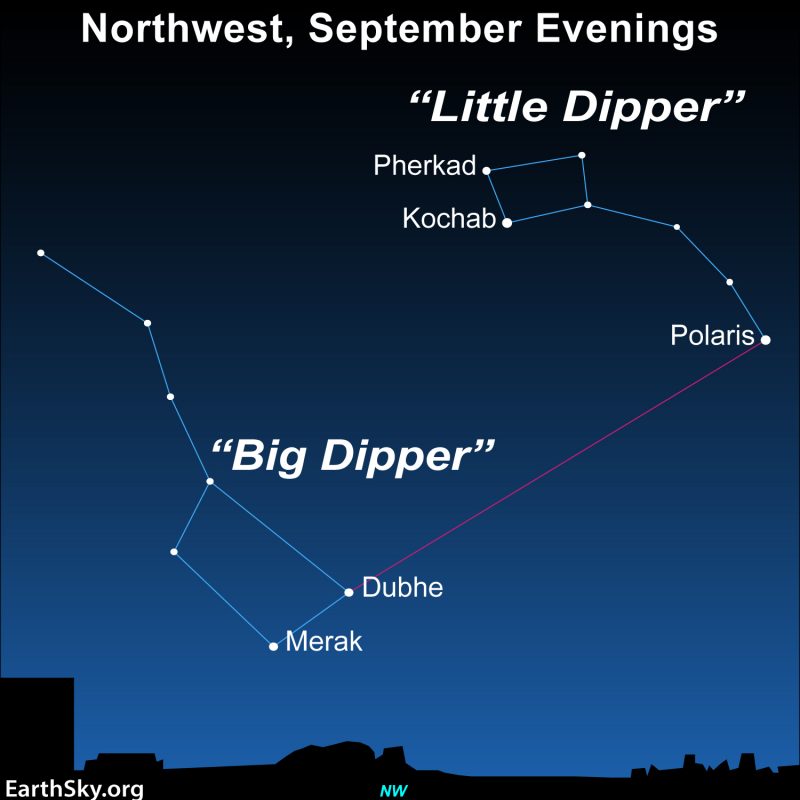
The Big Dipper, an easily recognizable pattern of seven bright stars known as an asterism, resides within the larger constellation Ursa Major, or the Great Bear. For centuries, it has served as a crucial navigational tool, guiding travelers with the guidance of its two outer stars, Dubhe and Merak, often referred to as "the Pointers," which point directly to Polaris, the North Star.
However, during September in the northern hemisphere, the Big Dipper appears to descend in the northwest sky, making it less noticeable for stargazers.
As Earth rotates on its axis, the northern sky appears to revolve around the North Star Polaris in a counter-clockwise direction. This means that, from night to night, the Big Dipper traces a circular path around Polaris, completing a full rotation of 361 degrees in the course of 24 hours. Consequently, when stargazers observe the Big Dipper at the same time each evening during September, they will notice that it is slightly lower in the northwestern sky compared to the preceding night.
This gradual descent continues throughout September and into October, causing the Big Dipper to become increasingly obscured in the evening sky for observers living at southern latitudes in the United States.
Interestingly, the Big Dipper is circumpolar for those living at higher latitudes, meaning that it never sets below the horizon and remains visible throughout the year from these regions. For instance, the Big Dipper and the nearby Cassiopeia constellation circle Polaris at a rate of 23 hours and 56 minutes each day. In ancient times, various cultures likened the Big Dipper's stars to a bear, with Greek and Roman mythology portraying it as the hindquarters and tail of the Great Bear, while the Mi'kmaq Indians saw it as hunters pursuing the bear.
Written by urgent.news from EarthSky's reporting — not their text. Machine-written — may contain errors; check the original before relying on it.