What can cutting a photon in half tell us about causality and local equivalence?
Calculations identify complicated consequences of removing a mirror The post What can cutting a photon in half tell us about causality and local equivalence? appeared first on Physics World .
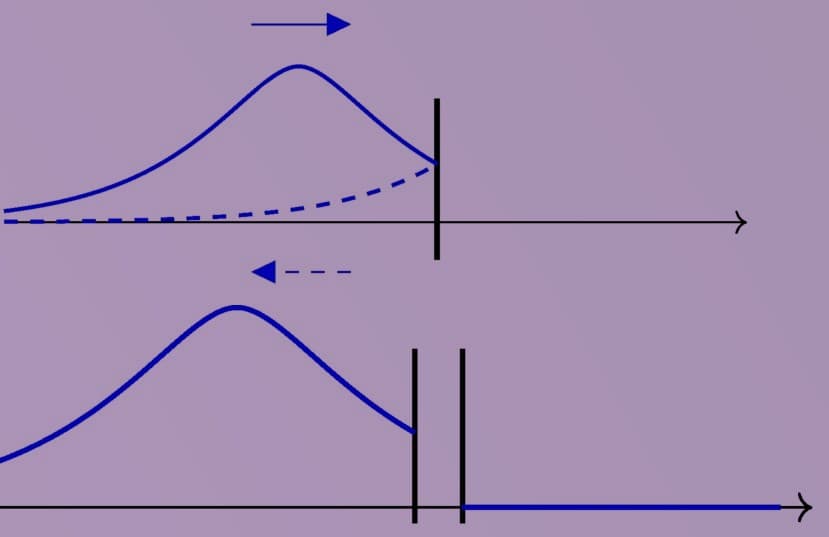
Cutting a photon in half does not immediately impact how an outside observer perceives the photon, according to a study by Norwegian physicists. The researchers found that within a small transition region where the mirror was removed, a large number of photons are needed to describe the truncated photon.
Quantum mechanics tells us that light exhibits both wave-like and particle-like properties. Light can be thought of as photons, which are excitations in quantum electromagnetic fields. In an ideal scenario, a photon is represented by an electromagnetic wave moving from left to right towards a mirror. If the mirror is removed, it "cuts" the photon in half, resulting in forward-moving and backward-moving modes.
However, the outcome is counterintuitive in the particle picture of light. Instead of finding a forward-propagating photon or not finding one, the physicist's calculations show a complicated state consisting of a classical mix and a quantum superposition of multiple photons.
The researchers used mathematical tools, including the Bogoliubov transformation, to understand how the definition of a particle or a vacuum state is a non-local concept. This transformation also describes how black holes eventually decay by emitting radiation. Despite the instantaneous change in the physical state of the electromagnetic fields, an observer far from the mirror, where light has not yet traveled, would not experience any change in the physical state.
Written by urgent.news from Physics World's reporting — not their text. Machine-written — may contain errors; check the original before relying on it.