The Polish Pavilion Dissolves You in the Politics of Sound
At the Venice Biennale, whale songs become a means for communication, opening up a dialogue on accessibility.
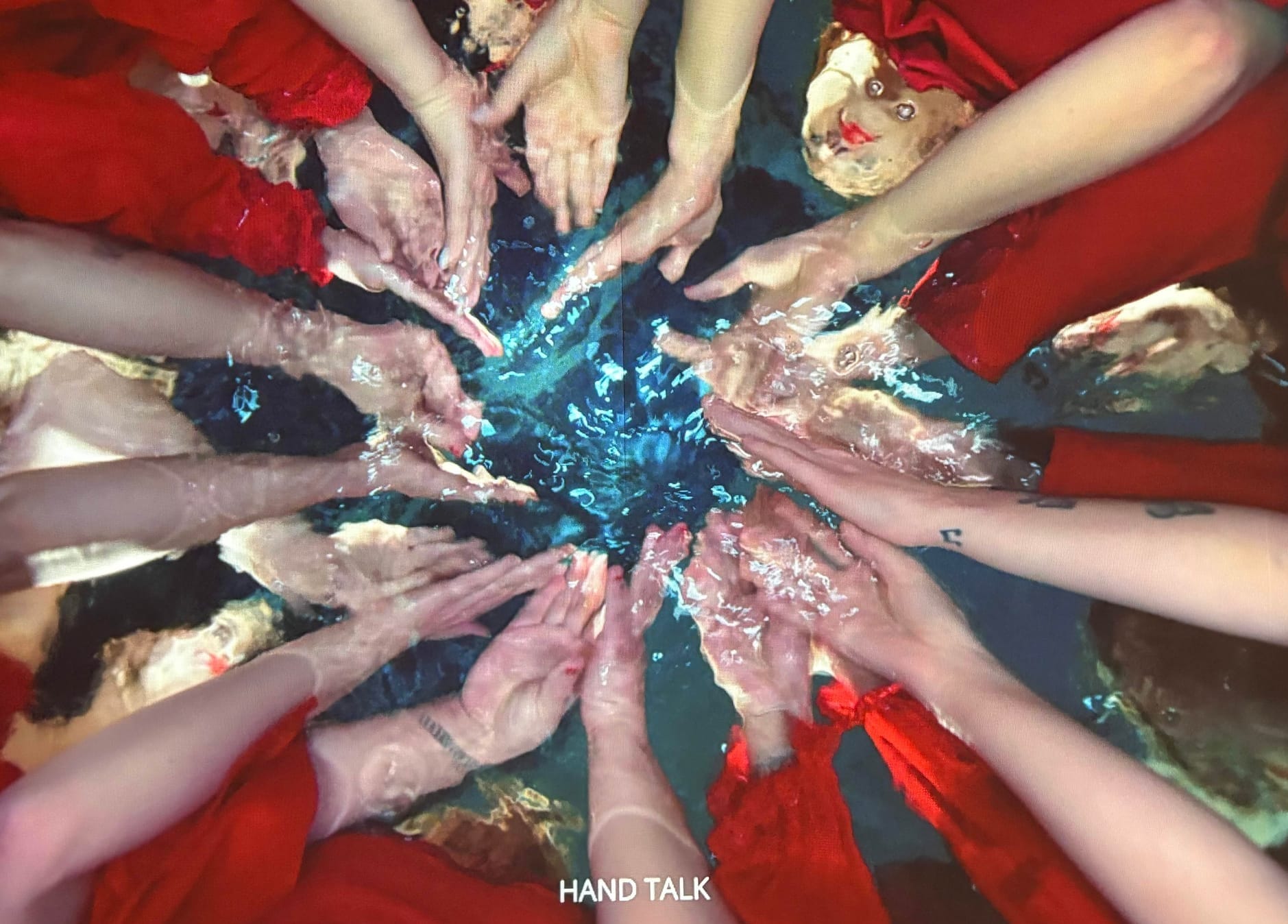
In the immersive space of the Polish Pavilion at the Venice Biennale, a groundbreaking installation called Liquid Tongues invites visitors to experience art through a wholly different lens. Curated by Ewa Chomicka and Jolanta Woszczenko and produced by Zachęta National Gallery of Art, this installation redefines accessibility as the very foundation of the artistic experience.
As soon as one steps into the pavilion, they are enveloped in a sea of blue, with video projections from a Warsaw swimming pool filling the room. Low-frequency acoustic waves, inspired by cetacean vocalizations and echolocation, ripple through the space, creating a tactile, bodily sensation rather than a passive auditory experience. For those whose sensory processing differs from the norm, this installation offers a profound alternative way of engaging with art.
At the heart of the artwork is "Chór w Ruchu (Choir in Motion)" (2026), a unique ensemble performance featuring both Deaf and hearing artists. These performers simultaneously narrate the story of biologist Roger Payne, whose 1970 recordings of humpback whales helped lead to the whaling ban. The story is told in phonic English and International Sign Language, blurring the lines between spoken and signed language.
The choreography, created by Alicja Czyczel, incorporates the principles of fish shoals, where bodies move as a single, distributed organism without any soloist or conductor. This organic movement creates a sense of unity and interconnectedness among the performers.
Aleksandra Gryka's score and Magda Mosiewicz's cinematography work in harmony to complete the structure, ensuring that no single channel — voice, sign, image, or vibration — holds primary status. Instead, everything is a form of translation, with each element contributing equally to the overall experience.
This installation is deeply rooted in the concept of "Deaf Gain," a term coined by Deaf Studies scholar H-Dirksen L. Bauman. This idea reframes deafness not as a disability but as a source of cultural and perceptual enrichment. Deaf artist Daniel Kotowski, whose work often explores language, biopower, and the oppression of phonetic training, is the driving force behind this innovative project.
By keeping the work in conversation with other artists who have brought Deaf epistemology to the forefront, such as Christine Sun Kim and Joseph Grigely, Liquid Tongues fosters a dialogue that transcends language and invites all visitors to experience art in a deeply transformative way.
Written by urgent.news from Hyperallergic's reporting — not their text. Machine-written — may contain errors; check the original before relying on it.