SC Collegium Recommends 12 Additional Judges For Permanent Posts Across Four High Courts
New Delhi, September 24, 2026: The Supreme Court Collegium has recommended the appointment of 12 additional judges as permanent judges in the High Courts of Andhra Pradesh, Kerala, Uttarakhand and Gauhati. The Collegium, comprising Chief Justice of India Surya Kant and Justices Vikram Nath and BV Nagarathna, took the decisions at its meeting on September 23. The recommendations cover five judges…
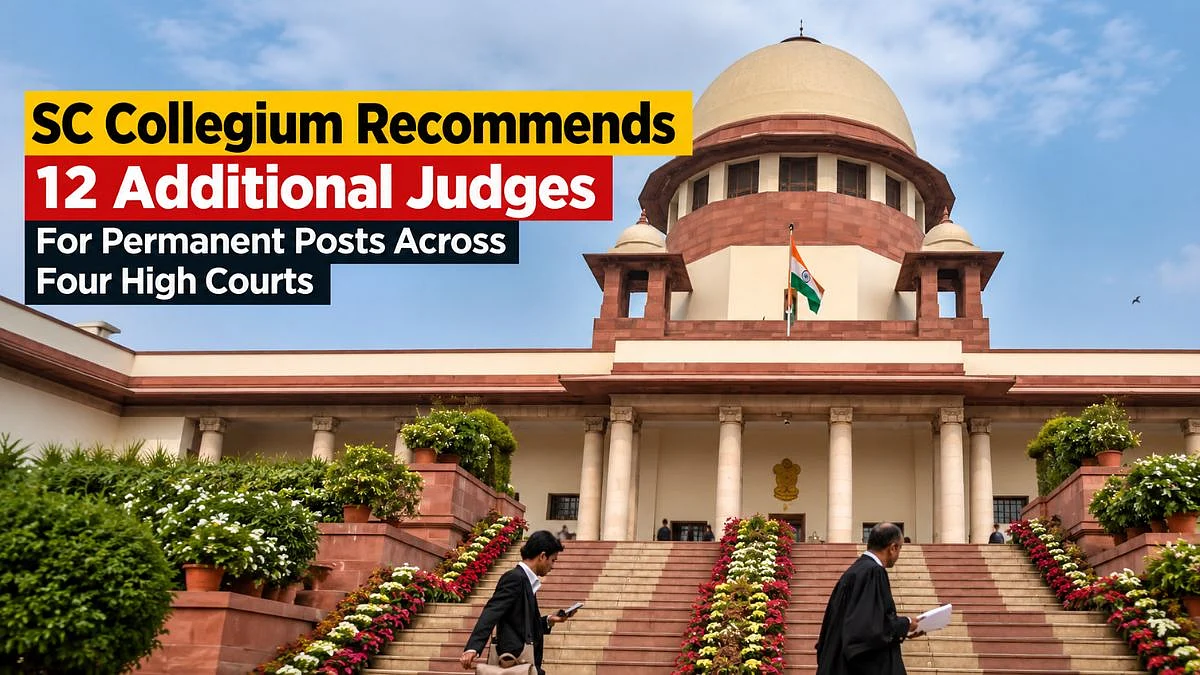
On September 24, 2026, the Supreme Court Collegium announced the appointment of 12 additional judges as permanent judges in four High Courts: Andhra Pradesh, Kerala, Uttarakhand, and Gauhati. The Collegium, led by Chief Justice of India Surya Kant and Justices Vikram Nath and BV Nagarathna, reached these decisions during their meeting on September 23. The recommendations include five judges for Andhra Pradesh, five for Kerala, one for Uttarakhand, and one for Gauhati.
In Andhra Pradesh, the Collegium recommended the appointment of five additional judges: Maheswara Rao Kuncheam (also known as Kuncham), Thoota Chandra Dhana Sekar (T.C.D. Sekhar), Challa Gunaranjan, Avadhanam Hari Haranadha Sarma, and Yadavalli Lakshmana Rao. The statement from the Collegium specified their names, illustrating a notable step toward providing permanent status to judges who are currently serving in an additional capacity.
For the Kerala High Court, the Collegium proposed the appointment of five more judges: P Krishna Kumar, KV Jayakumar, Muralee Krishna S, Jobin Sebastian, and PV Balakrishnan. Additionally, the Collegium recommended Justice Subhash Upadhyay, who presently serves as an additional judge, for appointment as a permanent judge in Uttarakhand.
Similarly, Justice Kaushik Goswami, an additional judge, was recommended for appointment as a permanent judge in Gauhati. The Collegium's resolutions for all four High Courts were recorded separately on September 23.
Written by urgent.news from Free Press Journal's reporting — not their text. Machine-written — may contain errors; check the original before relying on it.