Mexican EPICS in IEEE Team Builds Portable Educational Platform
In Guadalajara, Mexico, many high schools have motivated teachers and talented students with an interest in science, technology, engineering, and mathematics, but they lack access to advanced tools such as robotics laboratories. The resources shortfall limits the students’ opportunities for hands-on learning on cutting-edge applications. A team from ITESO, Universidad Jesuita de Guadalajara , is…
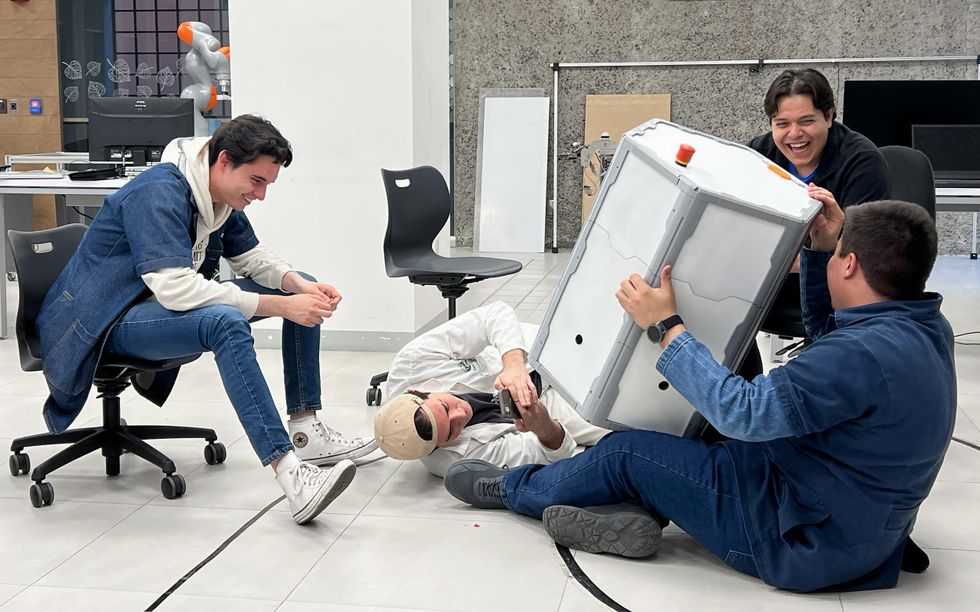
In Guadalajara, Mexico, many high schools boast dedicated teachers and gifted students with an interest in science, technology, engineering, and mathematics. However, these institutions lack access to advanced tools such as robotics laboratories, limiting students' opportunities for hands-on learning of cutting-edge applications. To address this, a team from ITESO, Universidad Jesuita de Guadalajara, is developing a portable educational platform called RoboMeshA.
The EPICS in IEEE initiative, administered by IEEE Educational Activities and funded by the IEEE Robotics and Automation Society, brought together 15 engineering students, faculty advisors, and IEEE Guadalajara Section volunteers to create RoboMeshA. This all-in-one mobile learning laboratory provides robotics and AI experiences to classrooms, eliminating the need for schools to build dedicated computer labs or install complex software.
Team member Fernando Vidal Luna explains that RoboMeshA enables students to interact with a robot through a user-friendly web browser, allowing them to control the robot manually or use its control modes to observe its movements and obstacle detection capabilities. Faculty advisor Jorge A. Lizarraga emphasizes that the project integrates mechanical design, embedded systems, control engineering, computer vision, and AI into a single robotic system, functioning as a mobile learning laboratory.
The team has already constructed two units and is developing a modular coupling framework to expand the system's capabilities for research and classroom demonstrations. The structured system design approach ensures independent software components work together while minimizing internal dependencies, allowing multiple RobotMeshA robots to operate concurrently.
The design process presented significant challenges, particularly in the robot's structural design. Luna explains that the chassis must not only fit all components and ensure stability, rigidity, and weight distribution but also protect the electronics for maintenance, testing, and modifications. Additionally, the team faced the challenge of accommodating students with varying levels of experience, ensuring that the platform remains simple and intuitive for beginners while still being engaging for advanced users.
To validate the platform, the team partnered with CETI Colomos and Prepa ITESO high schools, aiming to provide students with simple and intuitive initial interactions with the robot. Gonzalez highlights that students should be able to power the robot, connect to its network, and start interacting with it without dealing with software installation, extensive configuration, or troubleshooting.
Project lead Luis Fernando Luque-Vega, an IEEE member, sees RoboMeshA as a blueprint for engineering education, hoping it will be adopted by schools, universities, and IEEE student branches across Mexico and internationally. By combining engineering talent with community service, initiatives like EPICS in IEEE demonstrate how targeted support can transform academic concepts into real-world solutions, making engineering more meaningful for students.
Written by urgent.news from IEEE Spectrum's reporting — not their text. Machine-written — may contain errors; check the original before relying on it.