Measure Distant Asteroids With a DIY Rig
I’ve seen two total solar eclipses and have been duly impressed by what happens as the moon casts its shadow on Earth. But recently I’ve become even more intrigued by a similar phenomenon that doesn’t involve the sun or the moon—something called an asteroid occultation. That’s what happens when an asteroid orbits around the solar system and blocks the light of a distant star you’re viewing from…
Asteroid occultations, when an asteroid blocks the light of a distant star, offer a unique opportunity for amateur astronomers to study the celestial bodies that are otherwise difficult to measure with professional telescopes. These events, which occur when an asteroid orbits the solar system and casts a shadow on Earth's surface, can reveal the asteroid's shape and other valuable information.
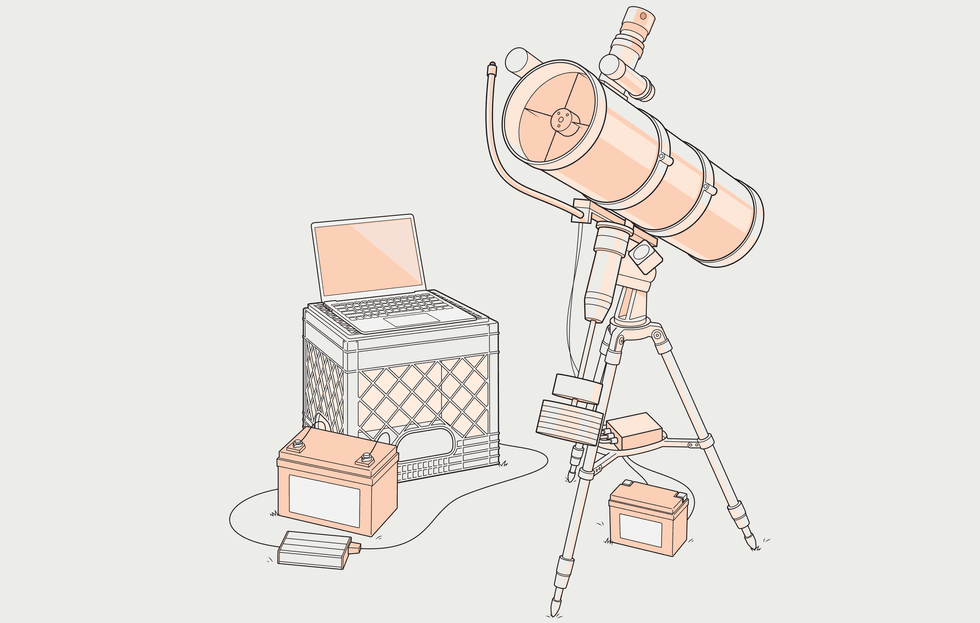
To catch an asteroid occultation, one can use a modest 5.1-inch-aperture Newtonian telescope attached to a small equatorial mount that can track the stars. The addition of a flasher with a calibrated time base provides a precise measurement of the occultation's duration. The flasher relies on a GPS module for high-accuracy timing, which is crucial for accurately capturing the fleeting shadow cast by the asteroid.
While a monochrome camera can provide larger field of view, a relatively inexpensive color camera can also be used for the task. Calculating the precise time and location for an occultation can be done using free PC software from the International Occultation Timing Association. To ensure accurate timing, practitioners often use a flasher—a red LED driven by a GPS receiver—to calibrate the images taken during the occultation.
With some effort, it's possible to reduce the uncertainty in time calibration to just a few milliseconds. The flasher can be programmed to produce calibrating pulses near the start and end of each recording session, preventing interference with the signal being detected. So far, the reporter has recorded four occultations within easy driving distance, with varying degrees of success and difficulty. These observations contribute to the scientific understanding of asteroids and their orbits.
Written by urgent.news from IEEE Spectrum's reporting — not their text. Machine-written — may contain errors; check the original before relying on it.