Learning style predicts survival skills in young orangutans
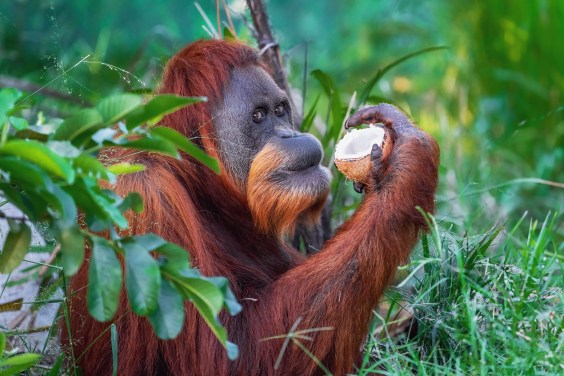
Orangutan infants spend their first eight years with their mothers, and throughout this time, they can draw on their knowledge. After that, however, orangutans are entirely on their own. To fare well as independent orangutans, infants need to learn many survival skills, arguably the most important of which are feeding skills.

Orangutan infants devote their initial eight years to learning survival skills under their mothers' guidance. As they mature, they must become fully independent, relying on the knowledge acquired during those early years. Dr. Revathe Thillaikumar, a researcher at the Max Planck Institute of Animal Behavior, explores how young orangutans master their complex diet during this crucial phase.
Adult orangutans consume nearly 250 distinct food items, some of which are potentially toxic, found throughout the rainforest. To understand how infants develop this diverse diet curriculum, Thillaikumar and colleagues studied 21 immature orangutans from birth to independence at around 8.5 years old, analyzing their learning behaviors and diet breadth.
The study reveals that orangutans acquire survival-relevant skills through a combination of social and individual learning. Infants typically engage in social learning, observing their mothers and other orangutans, five times more frequently than individual exploration. Social learning acts as a catalyst for subsequent exploration, lasting up to 2.5 hours per instance.
When both social and individual learning were high, orangutans had the broadest diet profiles at independence, while low engagement in both forms of learning resulted in the narrowest diet breadth. This research highlights the importance of social learning in shaping the dietary and ecological knowledge of great apes.
Written by urgent.news from Phys.org's reporting — not their text. Machine-written — may contain errors; check the original before relying on it.