KNUST launches Ghana Photonics and Optics Laboratory
The Kwame Nkrumah University of Science and Technology (KNUST) has outdoored a laboratory whose instruments read what is in a tablet of medicine, finds a parasite in a drop of blood, measure what is in our water and our soil, and carries our telephone calls along strands of glass.
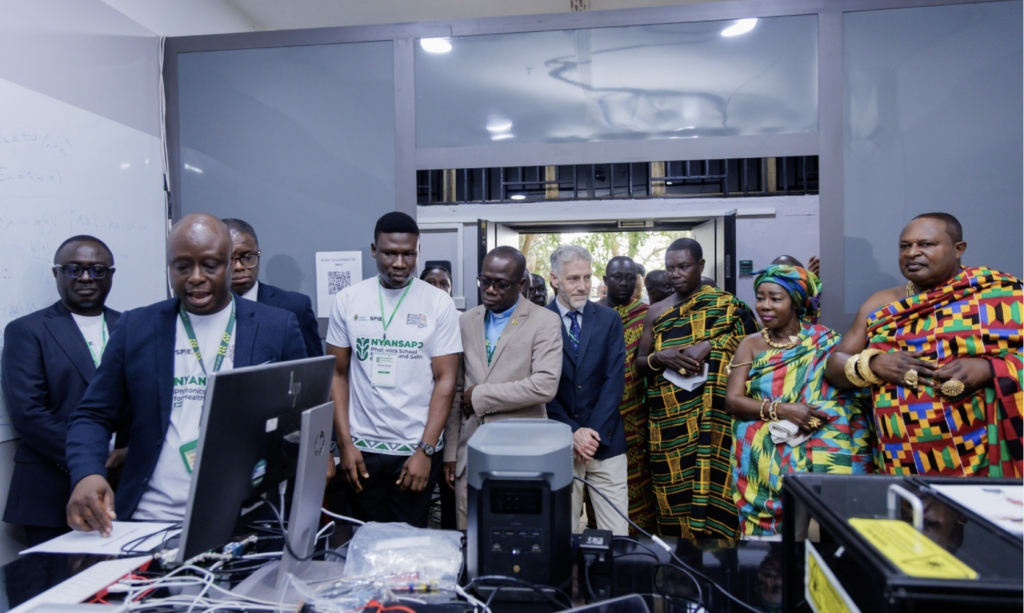
The Kwame Nkrumah University of Science and Technology (KNUST) has unveiled the Ghana Photonics and Optics Laboratory (GPOL), a facility equipped to analyze medicinal tablets, detect parasites in blood samples, measure water and soil content, and facilitate telephone communications via glass strands. As part of the Department of Physics at KNUST, GPOL marks the nation's first dedicated optics and photonics lab and the second in the country.
It emerged from research conducted by Dr. Akyana Britwum and Dr. Michael Kweku Edem Donkor, with initial support from SPIE, the International Society for Optics and Photonics. The laboratory aims to become a regional hub for photonics and optics expertise, nurturing new scientists and innovators, while advancing research.
Initially funded by SPIE, GPOL boasts a range of tools, including teaching and measurement kits, research and community-built instruments, and standard lab equipment. With the photonics industry projected to reach a $2.5 trillion market by 2024, Ghana and Africa require a robust photonics capacity. According to Professor Philip Antwi-Agyei, Provost of KNUST College of Science, the country's dependence on foreign assistance for light-based solutions has been a significant limitation.
The lab seeks to transform this dependency by offering tools that empower local scientists to tackle their respective challenges using light.
Professor David Asamoah, Pro Vice-Chancellor at KNUST, underscored the importance of the facility for Ghana, emphasizing that decisions concerning safety and trade have historically relied on foreign measurements. He called upon relevant government bodies, including the Food and Drugs Authority, Standards Authority, Environmental Protection Agency, and Minerals Commission, to maximize the potential of GPOL.
Dr. Peter de Groot, Chair of the GPOL Advisory Board and SPIE's 2025 President, stressed the need to overcome barriers, build capacity, foster scientific progress, and ignite an entrepreneurial spirit. SPIE is contributing to this mission by developing an international capacity-building framework, partnering with key stakeholders, and promoting training opportunities through the Spectroscopy, Optics, and Microscopy Training for West African Empowerment program.
The GPOL launch forms a centerpiece of the NYANSAPƆ Photonics School for Health and Safety, engaging 38 students from six African nations in laboratory sessions, plenary talks, distinguished lectures, and keynote addresses delivered by seventeen invited faculty members from Spain, the United States, the United Kingdom, France, Côte d’Ivoire, and Togo.
Written by urgent.news from MyJoyOnline Ghana's reporting — not their text. Machine-written — may contain errors; check the original before relying on it.