Curiosity rover insights after 5000+ sols on Mars
Curiosity rover has now spent 5,000 sols — the equivalent to 5,000 Martian days, or more than 14 years — on Mars. Here's a look at some of its discoveries. The post Curiosity rover insights after 5000+ sols on Mars first appeared on EarthSky .
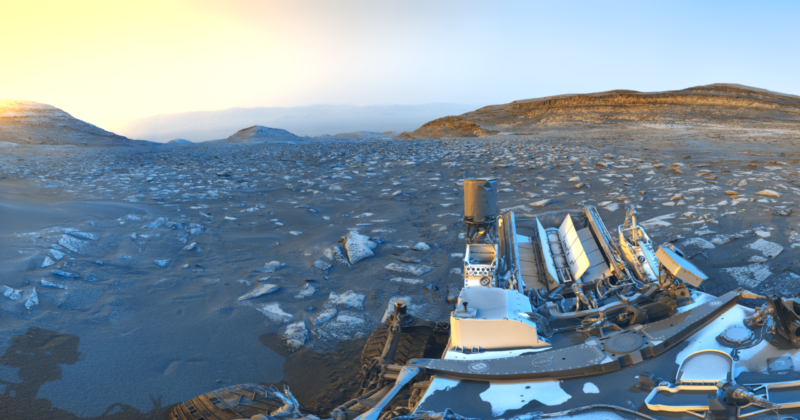
NASA's Curiosity Mars rover has been diligently exploring the red planet for over 5,000 sols, or Martian days, since landing in Gale Crater back in August 2012. The rover, which embarked on its 8-month journey to Mars from Cape Canaveral, Florida, in 2011, has traversed roughly 23 miles across the Martian surface, climbing more than a kilometer in elevation to reach the foothills of Mount Sharp.
Curiosity has made several significant discoveries during its time on Mars. Firstly, the rover found evidence that ancient Mars once had long-lived lakes and streams. It observed ripple patterns in the rocks, discovered high concentrations of minerals supporting the lake idea, and identified former mudflats. The drying of these ancient lakes can be attributed to Mars' weaker gravity and lack of a strong magnetic field, which allowed its atmosphere to dissipate over time, leading to a cold surface unable to sustain stable bodies of liquid water.
Secondly, Curiosity has confirmed that ancient Mars was probably habitable, providing conditions that could have supported microbial life. The rover observed clay minerals, sulfur, nitrogen, phosphorus, carbon, and chemical energy sources, all of which are key ingredients for life. Furthermore, Curiosity's recent findings have revealed the most diverse collection of organic molecules ever seen on Mars, with 21 carbon-bearing molecules discovered in a rock first sampled in 2020.
Lastly, after the surface dried up, Curiosity has uncovered evidence that groundwater continued moving through rocks beneath the surface. On Mount Sharp, the rover explored a network of ridges called boxwork, formed by groundwater once flowing through cracks in the rock and depositing minerals. Later, wind eroded the softer surrounding rock, leaving the mineral-filled cracks standing as ridges.
This discovery suggests that water remained underground long after Mars' surface became dry and inhospitable, potentially extending the time and places where microbial life could have survived.
Written by urgent.news from EarthSky's reporting — not their text. Machine-written — may contain errors; check the original before relying on it.
This story
This is one outlet's version. Read the fullest account.