Clastix bags €2.9M to tackle the complexity of Kubernetes at scale
Italy-based Clastix, a company developingtechnology for managing Kubernetes operations at scale, has raised €2.9 millionin seed funding to expand its team and accelerate the development of itsplatform...
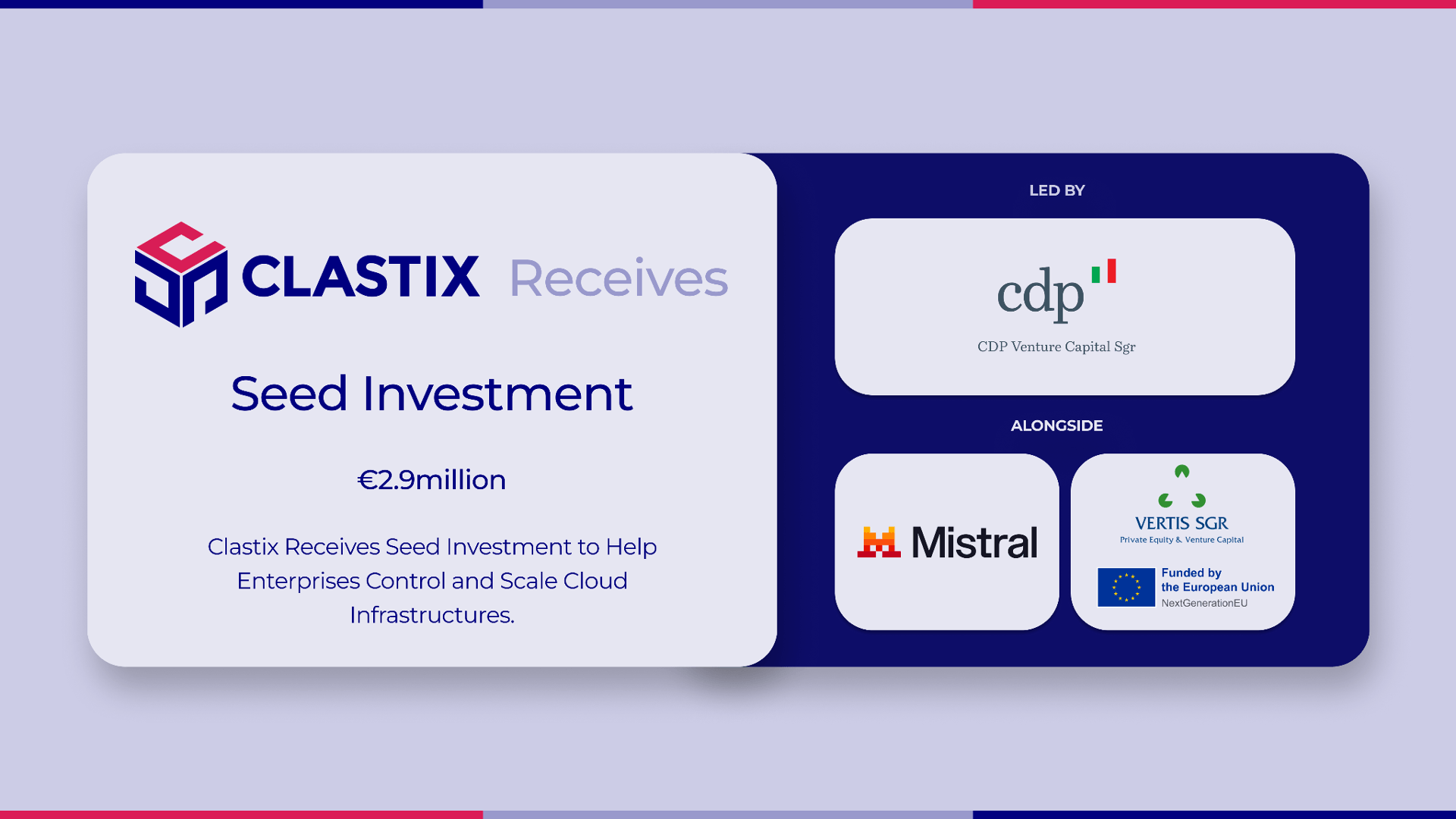
Italy-based Clastix, a company specializing in technology for managing Kubernetes operations at scale, has secured €2.9 million in seed funding to expand its team and accelerate platform development. The investment round was spearheaded by CDP Venture Capital Sgr, with Mistral and VERTIS SGR participating through its Vertis Venture 6 Digital Sud fund, which is partly funded by the European Union's Next-Generation EU programme.
Clastix focuses on providing infrastructure technology for organizations that operate Kubernetes across various teams, environments, and workloads. The company addresses the operational complexity that emerges as the number of Kubernetes clusters increases, particularly the need for dedicated machines and infrastructure to manage a control plane for each cluster.
Clastix's solution relocates Kubernetes control planes to shared infrastructure, enabling platform teams to decrease infrastructure overhead, streamline operations, and handle deployments on a larger scale. The technology comprises Kamaji, an open-source Hosted Control Plane engine, and kMetal, a commercial platform designed for managing Kubernetes operations across fleets.
While Kamaji remains open-source under the Apache 2.0 license, kMetal continues to evolve for fleet management, governance, and production operations. Clastix's technology is currently in use by infrastructure teams in Europe and North America, supporting AI labs, telecommunications companies, cloud services, and the public sector.
Adriano Pezzuto, Clastix's co-founder and CEO, highlighted that the infrastructure supporting AI workloads will play an increasingly vital role as the technology progresses. He emphasized that the next phase of AI development won't be dictated solely by models but by who controls the underlying infrastructure. The upcoming phase of AI entails expanding research and development efforts to better accommodate AI-scale workloads and expanding the team to penetrate new markets as organizations build their AI infrastructure.
Timothée Lacroix, Clastix's co-founder and CTO, noted that the company's Kubernetes infrastructure is supported by Clastix, with its focus on multi-tenancy and managed control planes facilitating Mistral's operations of training and inference clusters at scale. By investing in Clastix, Mistral is contributing to the development of Europe's AI ecosystem.
Clastix aims to utilize the funding for product development, customer success, solutions engineering, and market expansion as it expands kMetal. Additionally, the company plans to enhance its R&D capabilities to support AI workloads and continue investing in Kamaji. Over the next three years, Clastix anticipates workforce growth as it responds to customer demands and strengthens its enterprise team's capabilities.
Written by urgent.news from Tech.eu's reporting — not their text. Machine-written — may contain errors; check the original before relying on it.