Bundestag: Was dürfen Deutschlands Nachrichtendienste künftig?
Wie der BND künftig Hackergruppen lahmlegen und Lieferketten sabotieren könnte. Im Bundestag starten die Beratungen zu einer umfassenden Reform, die auch den Verfassungsschutz betrifft.
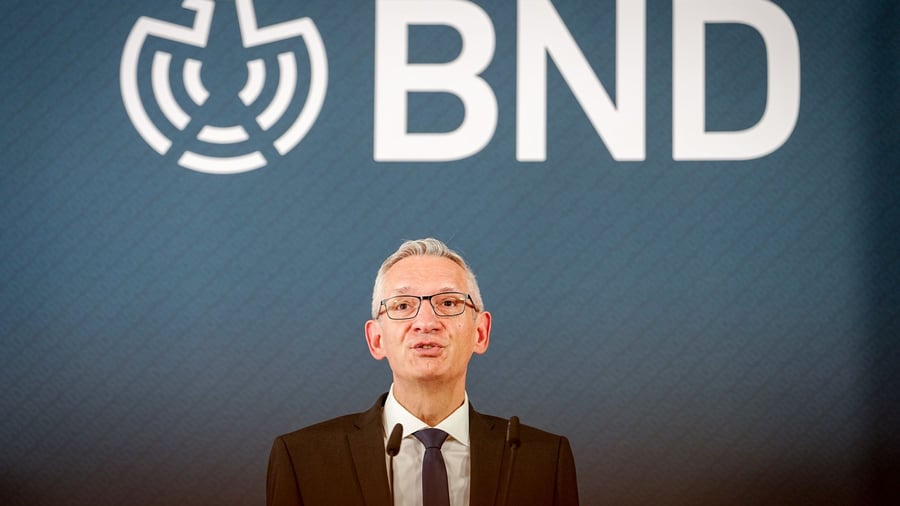
The German government aims to fundamentally reorganize the legal framework for the country's intelligence agencies. Interior Minister Alexander Dobrindt, representing the Christian Social Union (CSU), suggests that the Federal Office for the Protection of the Constitution (BfV) and the Federal Intelligence Service (BND) should become "true secret services." Discussions over the reform proposals have commenced in the Bundestag. The main questions and answers regarding this reform are as follows.
The government primarily cites the changed security landscape as the reason for the reform. Germany is increasingly becoming a target of espionage, sabotage, cyberattacks, and disinformation campaigns. These attacks, known as "hybrid," combine various means such as hacking, influence operations, espionage, sabotage, attacks, and other covert operations.
Many intelligence services of other countries with which Germany shares information are already more capable. They can provide information on weapons purchases by extremists or sabotage operations by other powers. For instance, "our services must be on a level playing field with our allies, this promotes equal collaboration and enhances security," says SPD fraction vice spokesperson Sonja Eichwede.
Additionally, decisions of the Federal Constitutional Court necessitate amendments, particularly to the rules for transmitting intelligence data to other authorities.
The BND's future capabilities include the direct response to a threat, such as destroying the IT infrastructure of a state-directed hacking group. Another possibility is manipulating production or supply chains to hinder the manufacture of drones, weapons, or explosives. Regarding Russia, BND President Martin Jäger stated at the Munich Security Conference that "I am deeply convinced that we should prove ourselves much more often that we are capable of doing very similar things, so that the other side feels the pain." However, killings should not be part of German intelligence services' repertoire.
To achieve these capabilities, IT experts who can disrupt digital systems and perform more advanced analysis are needed. Additionally, the placement of saboteurs or their recruitment for practical disruption maneuvers, such as those targeting the defense industry of a foreign power, would also be required. First, concrete objectives must be determined to send a deterrent signal in a threat situation deemed necessary politically.
Furthermore, identifying specific targets in a first step could provide a discouraging signal in case of a threat.
Regarding domestic intelligence services, the Federal Office for the Protection of the Constitution (BfV) will continue to gather information on extremist groups and engage in counterespionage. Under strict conditions, the BfV will be allowed to secretly enter premises, such as to install spy software for online surveillance or neutralize weapons and explosives.
However, arrests and interrogations, which the police are authorized to perform, remain prohibited for the Verfassungsschutz. Moreover, the monitoring of encrypted communication is to be expanded.
Several changes are planned generally, with stricter measures requiring stronger justifications for their implementation. Among other things, the use of artificial intelligence (AI) for analyzing large data sets and biometric matching of images will be regulated. Changes will also be made to the sharing of information with other authorities and, in specific cases, to private entities, such as when protecting critical installations is necessary.
Regarding oversight, the Independent Control Council, a court-like body, will review the legality of certain actions by the BND and BfV, including a preliminary review and related to data protection. The SPD emphasizes that this is crucial and will be closely examined in parliamentary discussions. The Left opposes the draft, warning of a possible "effectively abolishing the separation between intelligence services and police," a central lesson from Nazi Germany.
The AfD supports more operational capabilities for the BND but does not propose expanding the BfV's authority. The Greens broadly support a comprehensive reform of the intelligence services' legal framework but have their own ideas for effective oversight, stating that the draft does not sufficiently explain the reasons for equipping the Verfassungsschutz with police counter-terrorism capabilities while maintaining secrecy.
Written by urgent.news from Handelsblatt's reporting — not their text. Machine-written — may contain errors; check the original before relying on it.