AI-powered fuzzing with the GitHub Security Lab Taskflow Agent
In this blog post, I explain how to use the new fuzzing taskflow based on the GitHub Security Lab Taskflow Agent AI framework. The post AI-powered fuzzing with the GitHub Security Lab Taskflow Agent appeared first on The GitHub Blog .
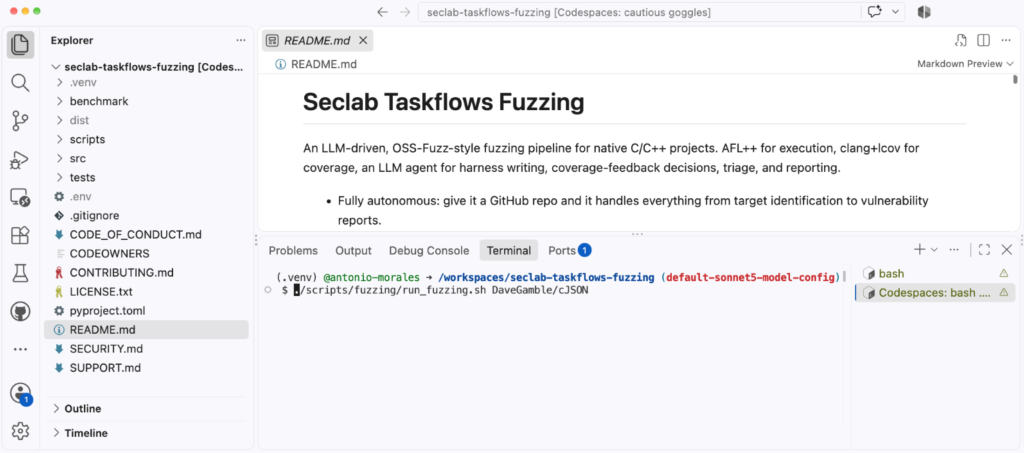
Title: AI-enhanced Fuzzing with GitHub Security Lab Taskflow Agent
The Fuzzing Taskflow Agent from the GitHub Security Lab is an innovative tool that automates the fuzzing process for C/C++ projects in a GitHub repository. Fuzzing is a testing technique that helps uncover critical bugs by providing invalid or unexpected inputs. However, it still requires human oversight, such as monitoring coverage, writing harnesses for unexplored code, and triaging the crashes.
The Fuzzing Taskflow Agent aims to minimize the human effort required in these manual tasks. By simply pointing the agent to a GitHub repository, it takes care of the entire fuzzing workflow, including identifying entry points, analyzing the build system, writing harnesses, running AFL++, reading coverage reports, enhancing harnesses, triaging crashes, and generating a vulnerability report for each unique bug.
The agent operates through a framework called Taskflow Agent, which is built on top of the GitHub Security Lab Taskflow Agent. The pipeline itself is expressed as a series of taskflows that the agent runs sequentially. This allows for a clear separation of responsibility, where the LLM agent makes decisions and the MCP tools execute tasks like running AFL, compiling harnesses, and storing crashes.
The agent uses a SQLite database to store state, ensuring that data is passed through the database rather than in memory between stages. This ensures data integrity and prevents accidental exposure of sensitive information. One notable aspect of the agent is the use of two binary files for each harness: an AFL binary built with afl-clang-lto -fsanitize=address,undefined, and a coverage binary built with clang -fprofile-instr-generate -fcoverage-mapping.
The AFL binary performs the fuzzing, while the coverage binary replays AFL's queue to generate accurate source-line and branch coverage.
The agent utilizes Claude Sonnet 5 as its default model, known for its ability to operate without security guardrails. However, users can choose a different model by modifying the model_config.yaml file. The architecture of the Fuzzing Taskflow Agent consists of three layers: a shell driver script (run_fuzzing.sh) that chains the pipeline stages, a set of taskflow YAMLs that serve as prompts for the LLM agent, and a set of MCP tools responsible for executing tasks like running AFL, compiling harnesses, and managing crashes.
By automating the manual, iterative process of improving fuzzing coverage, the Fuzzing Taskflow Agent significantly reduces the workload on human testers, enabling them to focus on more complex tasks. However, it is crucial to run the agent inside a disposable environment, such as a Codespace or a throwaway VM, to prevent any potential security risks.
Written by urgent.news from GitHub Blog's reporting — not their text. Machine-written — may contain errors; check the original before relying on it.