UK replies to Milei: "not the behaviour we expect of a democracy"
The United Kingdom has asked for a written statement to be placed in the official record of the UN General Assembly in response to Argentine President Javier Milei's address, saying Buenos Aires' conduct over the Falklands "is wholly incompatible with the principles established in the United Nations Charter and is not the behaviour we expect of a democracy".
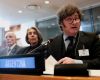
The United Kingdom has sought a written statement to be recorded in the UN General Assembly's official documentation in response to Argentine President Javier Milei's address. The UK maintains that Buenos Aires' actions regarding the Falkland Islands are "wholly incompatible with the principles established in the United Nations Charter and are not the behaviour we expect of a democracy."
This statement was submitted under agenda item eight of the 81st session, following Milei's assertion on sovereignty over the Falkland Islands and South Georgia and the South Sandwich Islands. The British statement reaffirms the UK's unwavering commitment to its sovereignty over these territories and their surrounding maritime zones, as well as its firm support for the Islanders' right of self-determination, as outlined in the UN Charter and Article 1 of the two international human rights covenants.
Argentina, on the contrary, continues to dispute the applicability of this fundamental human right to its inhabitants, actively seeking opportunities in international forums to fortify its sovereignty claim. The UK's response directly refutes Milei's legal argument, asserting that General Assembly Resolution 2065 neither prohibits economic development nor diminishes the Islanders' right of self-determination.
Similarly, it contends that Resolution 31/49 does not restrict the Islanders' rights to determine their political status or pursue their economic, social, and cultural development freely. The UK also emphasizes that calls for negotiations do not alter or weaken the nations' obligation to respect the Islanders' legally binding right of self-determination.
Regarding ongoing disputes involving oil companies and other local industries, the UK asserts that attempts to obstruct and harass these entities are entirely unacceptable, as they constitute an extraterritorial jurisdiction without any justification in international law. The document also highlights a 2013 referendum in which 99.8% of voters opted to maintain the current status, with a 92% turnout, and notes that this vote was monitored by independent observers from Canada, the United States, New Zealand, and three South American nations: Uruguay, Chile, and Brazil.
The statement concludes a 48-hour period, following Prime Minister Andy Burnham's inclusion of the archipelago among challenges to the rule of law in his address earlier that day. Argentine Foreign Minister Pablo Quirno subsequently exercised the right of reply before the plenary, asserting that the illegal British occupation of the islands dates back to January 1833 when the authorities and established Argentine population were expelled.
Milei addressed the UN General Assembly on Wednesday, and the UK's statement followed shortly thereafter. Argentina currently holds 60 administrative proceedings without any penalties and has three criminal complaints against ten companies and their directors, none of which have been proven.
Written by urgent.news from MercoPress's reporting — not their text. Machine-written — may contain errors; check the original before relying on it.
Also reported by 1 other outlet
- UK replies to Milei: "not the behaviour we expect of a democracy" en.mercopress.com