Robot dog ran a marathon on one charge and lived to publish the paper
Two years later, creators explain how lightweight hardware and reinforcement learning helped it go the distance
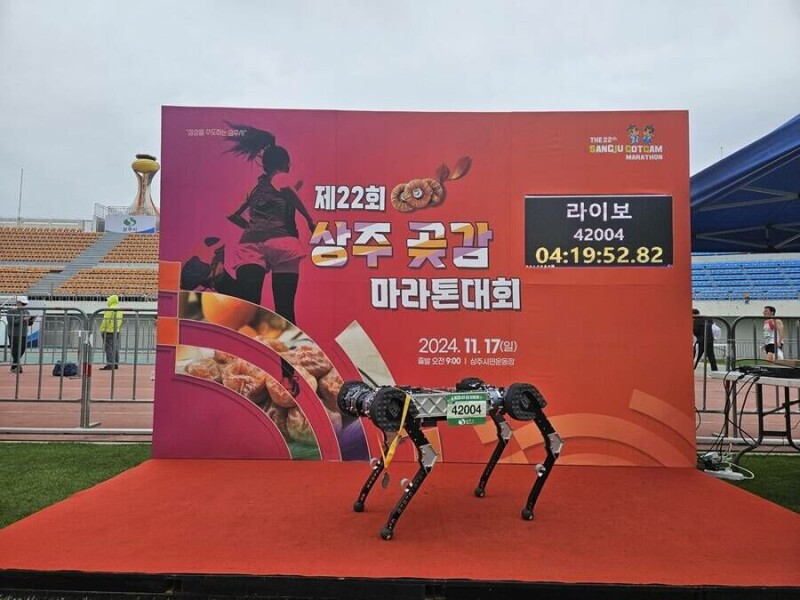
South Korean scientists have unveiled the groundbreaking capabilities of their quadruped robot, RAIBO2, in a recent publication in Nature. The robot successfully completed a full marathon distance of 42.195 km (26.2 miles) during the Sangju Dried Persimmon Marathon in November 2024, finishing in a time of 4 hours, 19 minutes, and 52 seconds. This accomplishment marks the first time a quadruped robot has crossed the finish line at an official marathon event.
The research team, led by associate professor Jemin Hwangbo at the Korea Advanced Institute of Science and Technology (KAIST), has made significant strides in enhancing the energy efficiency of RAIBO2 compared to previous quadruped robots. Their innovative approach has resulted in a remarkable improvement of over three times the range per battery charge. This breakthrough has opened up new possibilities for extended outdoor applications where prolonged battery life is essential.
While RAIBO2's efficiency surpasses that of current quadruped robots, it is important to note that the robot still requires human operation for certain terrains, such as stairs or mountainous areas. The researchers acknowledge that autonomous navigation necessitates planners capable of identifying energy-optimal paths based on global map understanding. Nevertheless, the loss models developed in this study lay a solid foundation for tackling these challenges.
The versatility of quadruped robots is evident in their ability to traverse uneven terrain, including stairs, rubble, and slopes. This adaptability makes them particularly useful in mountainous regions and disaster zones. Notably, robot dogs like RAIBO2 have already been deployed to assist in the nuclear clean-up at the UK's Sellafield facility, demonstrating the practical applications of such technology.
The trade-off, however, is range. Traditional quadrupeds typically achieve around 20 km per charge due to the energy required to support their weight and the additional losses from repeated contact between their feet and the ground. In contrast, RAIBO2 completed the marathon at an average speed of 2.64 meters per second while negotiating 286 meters of elevation change and slopes reaching 18.4 degrees.
Its total cost of transport – the energy required to move a given weight over a given distance – was recorded at 0.25, compared to the human benchmark of 0.37, showcasing its superior efficiency.
The researchers emphasize that while RAIBO2 has set a new efficiency record, it is not entirely autonomous. Specific terrains may still require adjustments to energy loss models and constrained robot postures, necessitating more environment-aware strategies. However, the foundation laid by this study paves the way for future advancements in legged robot technology, potentially extending their range and capabilities to various applications, from disaster response to delivery services.
Written by urgent.news from The Register's reporting — not their text. Machine-written — may contain errors; check the original before relying on it.