OpenAI expands GPT-6 lineup with cheaper Sol and Luna models
Anthropic and OpenAI both unveiled new model updates today, with Claude Opus 5.5 and GPT-6 Sol & Luna introduced within a short span of each other. Claude Opus 5.5 was the first to be announced today, so we will begin with that. Anthropic revealed that the newest model update matches the performance of Claude Fable 5.1 across most tasks, while reducing computational costs by approximately 40% in comparison to Opus 5, which was already half the price of Fable 5.
Opus 5.5 requires less computing power for operation, and this is reflected in its pricing. According to our tests, at default settings, it costs 40% less than Opus 5 on regular workloads. Input and output tokens are priced at $4 and $20 per million, respectively, which is 20% less than Opus 5. Cache reads, which account for the majority of agentic and coding tasks' expenses, are priced at $0.20 per million tokens, a 60% decrease from Opus 5.
Furthermore, Opus 5.5 generates output more than 30% faster than Opus 5. Despite the lower computational costs, Anthropic claims that Opus 5.5 is more potent, outperforming Fable 5.1 in every metric and also surpassing OpenAI's GPT-6 Astra in virtually every category, including agentic coding, knowledge work, and more. Claude Opus 5.5 is now accessible on "all platforms," according to Anthropic.
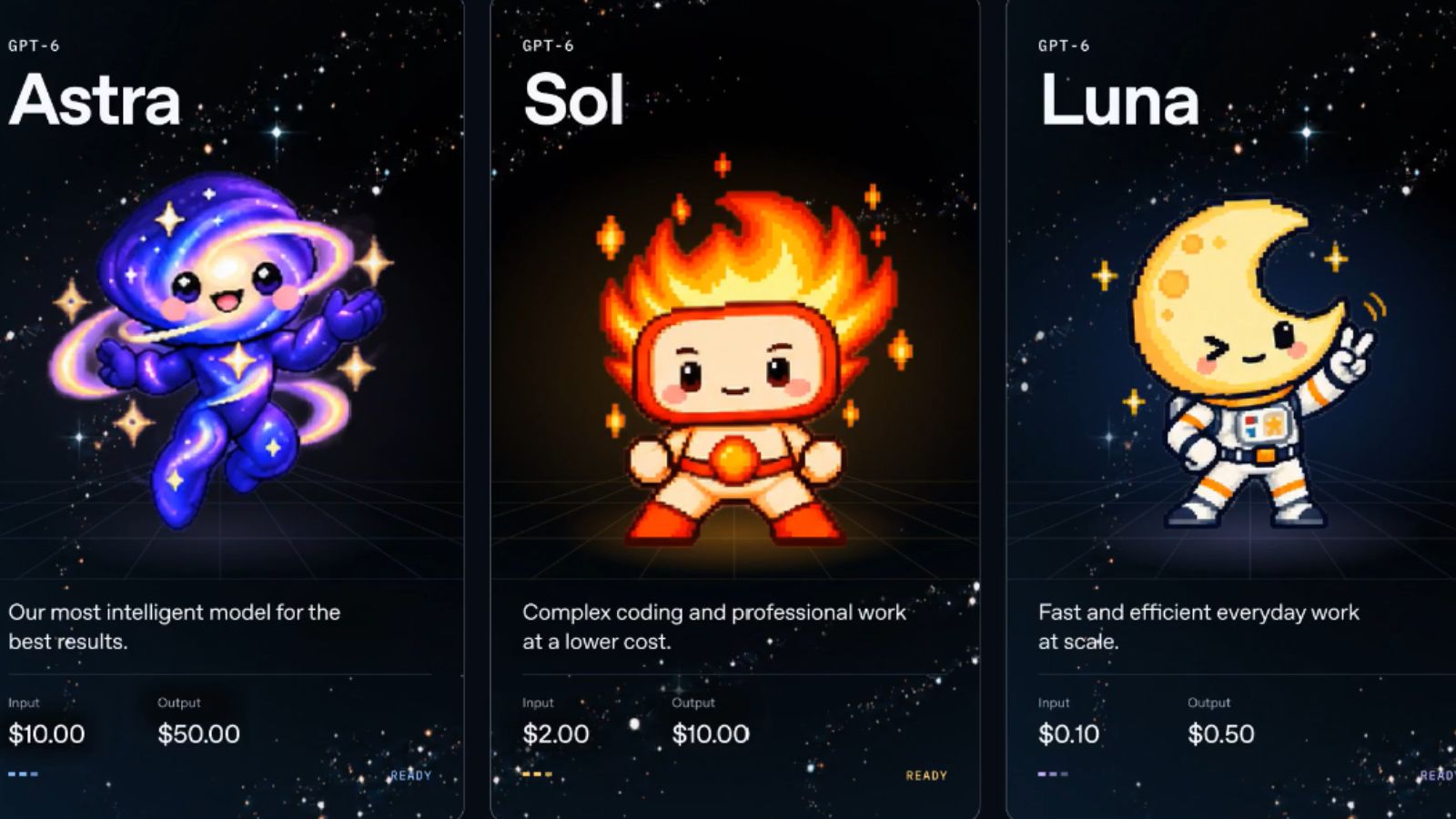
Just an hour after Claude's announcement, OpenAI released its own GPT-6 Sol & Luna models, also emphasizing cost reduction. Similar to Opus 5.5, OpenAI claims that both GPT-6 Sol and Luna are significantly less expensive to run compared to their GPT-5.6 counterparts. Specifically, both models are around 50% cheaper in terms of input and output per 1 million tokens in API usage.
While these models are marginally more powerful than their predecessors, they fall short of Astra, which remains OpenAI's most capable model. Luna prioritizes cost efficiency, while Sol offers a balance between affordability and enhanced performance, outperforming Luna but at a more economical price than Astra. OpenAI trained GPT-6 Sol and Luna using similar techniques as GPT-6 Astra, transferring Astra's state-of-the-art performance in professional work, factuality, coding, computer usage, and alignment to more affordable and faster models.
The GPT-6 models lead across the cost-intelligence spectrum, offering exceptional capabilities at every level while delivering them efficiently at scale. By enhancing caching and inference, OpenAI has managed to serve these models at lower costs, and they are passing these savings on to users and customers by decreasing API prices for Sol and Luna by 50% compared to their original GPT-5.6 promotional pricing.
Currently, Sol and Luna are available in ChatGPT Work and Codex for Plus, Pro, Business, Enterprise, and Edu users. Luna is available in the desktop app for Free and Go users, but neither model is available in the regular Chat function at this time.
Written by urgent.news from 9to5Google's reporting — not their text. Machine-written — may contain errors; check the original before relying on it.
This story
This is one outlet's version. Read the fullest account.
- Claude Opus 5.5 and OpenAI GPT-6 Sol & Luna both launch today with lower costs 9to5google.com
- GPT-6 Sol costs $2/1M input and $10/1M output tokens, and GPT-6 Luna costs $0.10/1M input and $0.50/1M output tokens, both about 50% cheaper than GPT-5.6 (Nat Rubio-Licht/The Deep View) thedeepview.com
- OpenAI expands GPT-6 lineup with cheaper Sol and Luna models economictimes.indiatimes.com
- OpenAI launches GPT-6 Sol, Luna at half the API cost techinasia.com
- OpenAI expands GPT-6 lineup with cheaper Sol and Luna models channelnewsasia.com