NASA's Hubble seeks lensed supernova, marks 200,000 orbits
NASA's Hubble Space Telescope completed its 200,000th orbit around Earth on Sept. 19, marking another milestone for an observatory that continues to transform our understanding of the universe.

NASA's Hubble Space Telescope celebrated its 200,000th orbit around Earth on September 19, reinforcing the telescope's ongoing influence on our cosmic understanding. Throughout its 36-year mission, Hubble has ventured more than 5 billion miles (8 billion kilometers) from Earth and captured over 1.7 million observations.
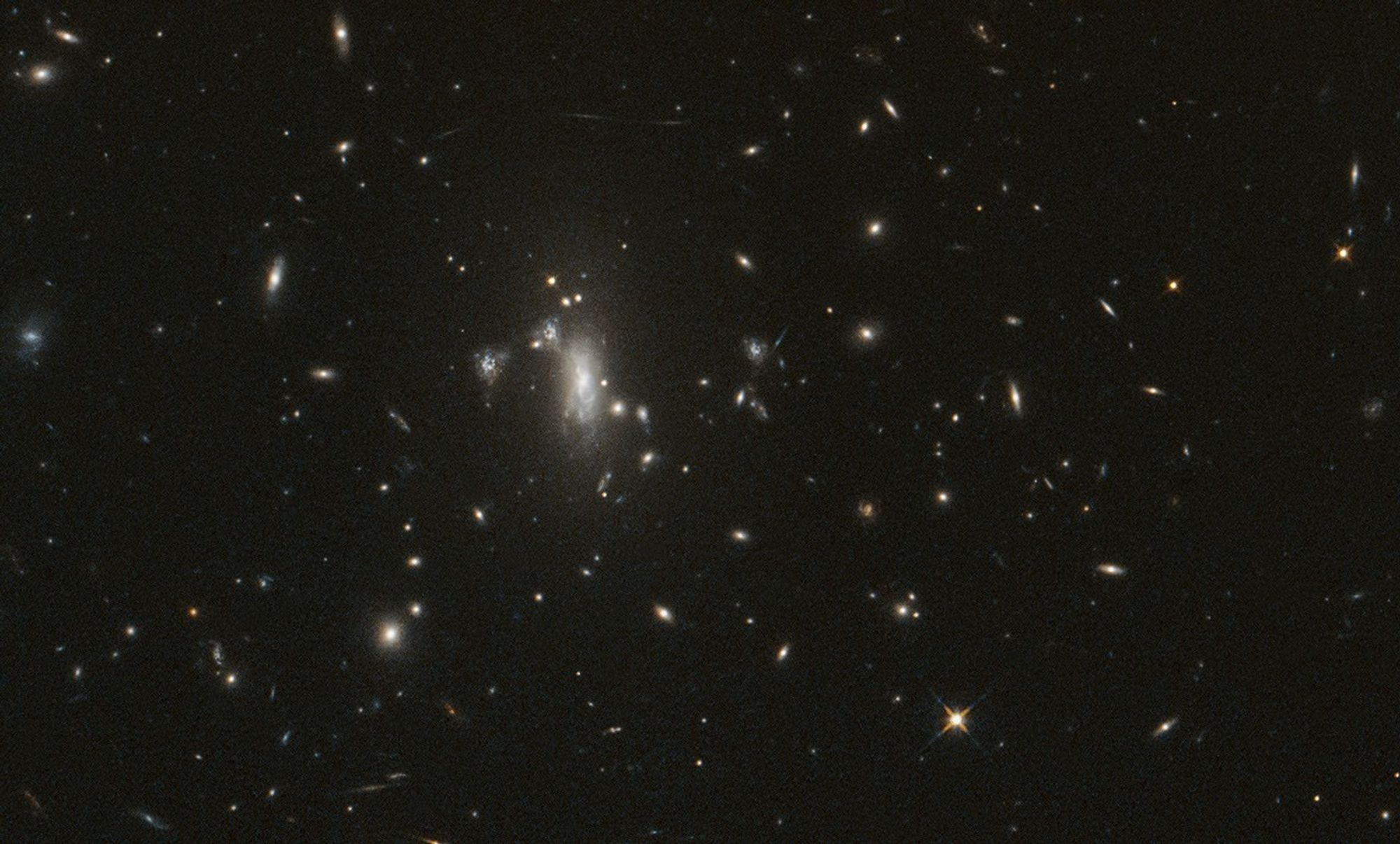
A significant contribution to Hubble's legacy is its role in determining the universe's expansion rate, or the Hubble constant. On the day of its 200,000th orbit, Hubble's efforts were directed towards monitoring the reappearance of a supernova, referred to as Athena. This particular galaxy cluster, MACS J0417, situated at the image's left center, functions as a gravitational lens, distorting and intensifying light from celestial bodies situated behind it.
Light from a supernova can traverse multiple paths, causing the same stellar explosion to be visible on Earth more than once, with intervals ranging from months to years based on the light's trajectory. Supernova Athena, initially detected by NASA's James Webb Space Telescope in 2025, is anticipated to reappear between the current date and early March 2027.
Tracking the timing of these reappearance events can assist researchers in determining the mass of MACS J0417, serving as a natural lens for distant objects, and enhancing our comprehension of the universe's expansion rate.
Despite more than three decades in space, Hubble remains a source of cutting-edge scientific productivity and impact. The telescope's unique capability to perceive and analyze ultraviolet and visible light synergizes with the capabilities of NASA's James Webb Space Telescope and the Roman Space Telescope. However, demand for Hubble observing time remains substantial, with astronomers typically seeking about seven times the available time each year.
Hubble persistently observes subjects spanning all areas of astronomy around the clock, and real-time tracking of these observations is accessible on NASA's website.
Written by urgent.news from Phys.org's reporting — not their text. Machine-written — may contain errors; check the original before relying on it.
This story
This is one outlet's version. Read the fullest account.
- NASA’s Hubble Seeks Lensed Supernova, Marks 200,000 Orbits science.nasa.gov