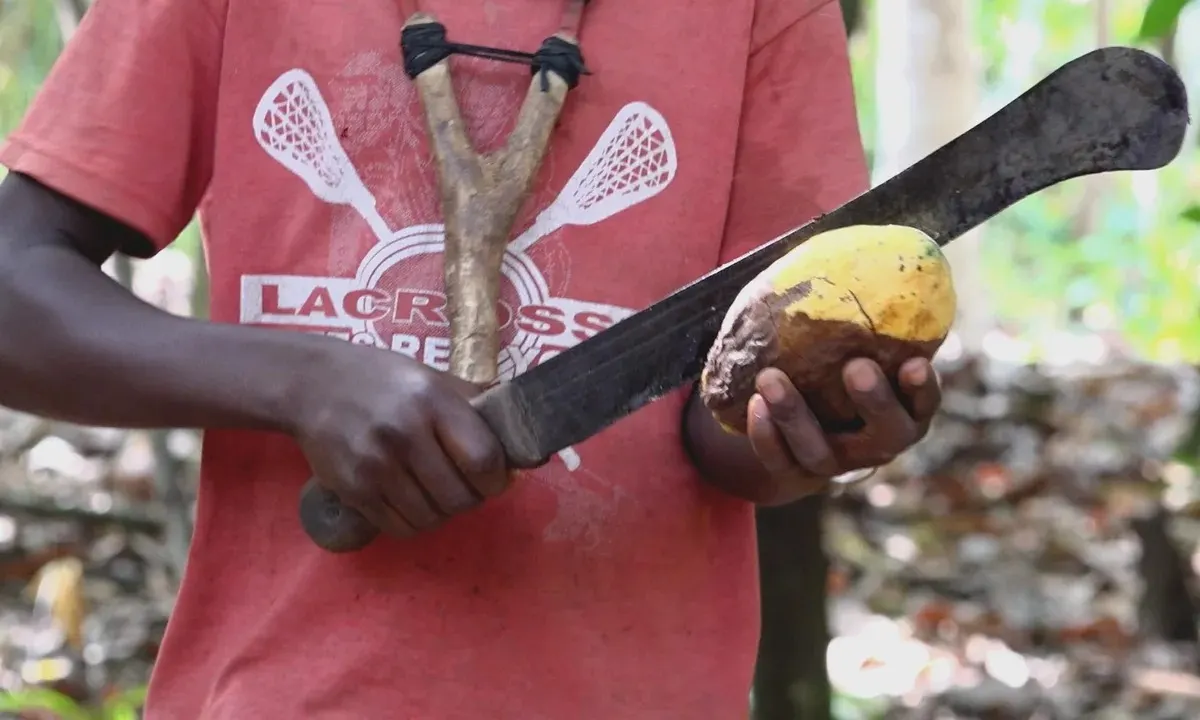
How an American rescued over 300 children from serving as labourers on cocoa farms in Eastern Region of Ghana
It is the Abna Dakwa Village, in the Eastern Region of Ghana, in a cocoa-farming area.
For centuries, the family farm has been a cornerstone of American society. However, recent times have posed significant challenges for farmers, who are grappling with soaring expenses, overwhelming debt, and the same economic struggles faced by the broader populace. Judy Woodruff explores the complexities of maintaining a farm and who will perpetuate this tradition in her series, Crossroads: America at 250.
Underneath Western Kansas sun, Cole Carpenter of Triple C Farms lamented the lack of a corn harvest this fall due to a severe drought that stifled growth in the summer. Carpenter remarked, "It's tough, no matter which way you look at it."
For generations, farming has been an integral part of the American identity. At the nation's inception, 90% of Americans were farmers. Today, that number has dwindled to less than 2%. Agricultural journalist Sarah Mock, author of "Farm (and Other F Words): The Rise and Fall of the Small Family Farm," shared this historical context with Woodruff during a visit to Old Town Farm in Albuquerque, New Mexico, a former horse farm transformed into a cafe and event space.
Mock recounted Jefferson's vision of America as an agricultural powerhouse, emphasizing the community, loyalty, and patriotism shared by yeomen farmers. Carpenter echoed the sentiment, acknowledging the gamble inherent in farming. "Farming is a gamble," he stated.
Woodruff recounted her initial meeting with Carpenter at his farm near Leoti, Kansas, two decades ago, when he was still rearing to become a millennial. Carpenter's grandfather, Dale Appl, had been farming for decades, with the land's lineage tracing back to the late 1800s. Despite Appl's years of farming, doubts lingered about whether farming could sustain the next generation.
Twenty years later, the Carpenters continue to farm, having expanded their operation to 10,000 acres, added cattle, and established a crop spraying business. However, their margins remain slim. Two years ago, Cole and his wife, Bridget, sold 800 acres to bolster the farm's finances. Carpenter admitted the decision was agonizing, admitting, "It doesn't go easily."
Carpenter highlighted the growing challenge of securing capital and managing debt as the primary obstacles facing farmers. He explained, "All the technology, all the seed we have, we're able to grow more, but it also comes with a cost."
Despite implementing cutting-edge technology, farmers still confront uncontrollable factors such as weather, commodity prices, land costs, politics, and tariffs. Carpenter lamented, "We're just trying to survive."
Mock's book, "Farm (and Other F Words): The Rise and Fall of the Small Family Farm," delves into these challenges, particularly the hurdles faced by first-generation farmers. She noted that inheriting land is nearly impossible, underscoring the difficulty of maintaining a small family farm without financial backing.
Written by urgent.news from PBS NewsHour's reporting — not their text. Machine-written — may contain errors; check the original before relying on it.
This story
This is one outlet's version. Read the fullest account.