Gather 'Round, Willie Birch Is Speaking
Across five decades of work, he always asked: What's my neighborhood, and what does it need?
Step into the California African American Museum and prepare to be enveloped in the world of Willie Birch, an artist whose career has spanned five decades. This exhibition, his first solo showcase, offers a glimpse into the man and his artistry, revealing a deep fascination with people, particularly Black individuals, and their experiences.
Birch's work is a testament to his keen eye for community practices and the ways individuals navigate their lives, with a particular emphasis on the impact of past actions on present-day activities.
The exhibition begins in the 1970s, a time when Birch was captivated by the patterns and behaviors within Black traditions and histories. Pieces like "Voodoo Series #1" (1978-1979) and "Passages" (1982) showcase his ability to blend ancient spiritual and medicinal symbols with contemporary household technology, as well as his exploration of movement across oceans through carved wooden figures set against a painted, fluid background.
His New York City Jazz Series (1978) demonstrates his adaptation to a new environment, using invented symbols to mimic jazz musical notation and capture the essence of his surroundings.
As the exhibition progresses, Birch introduces paper-mâché into his technique, bringing a three-dimensional element to his work. Large-scale New York scenes emerge, told through graphite, charcoal, and acrylic paint, while paper-mâché frames provide context to the narratives. Works such as "Keeping Up with the Iran-Contra Hearings" (1987) and "Birthday Celebration for Nelson Mandela" (1988) reflect on the concerns of the Black community in New York, intertwining personal and national issues within the city's landscape.
These larger-than-life pieces serve as a bridge between the artist's earlier works and his subsequent exploration of life-size figures.
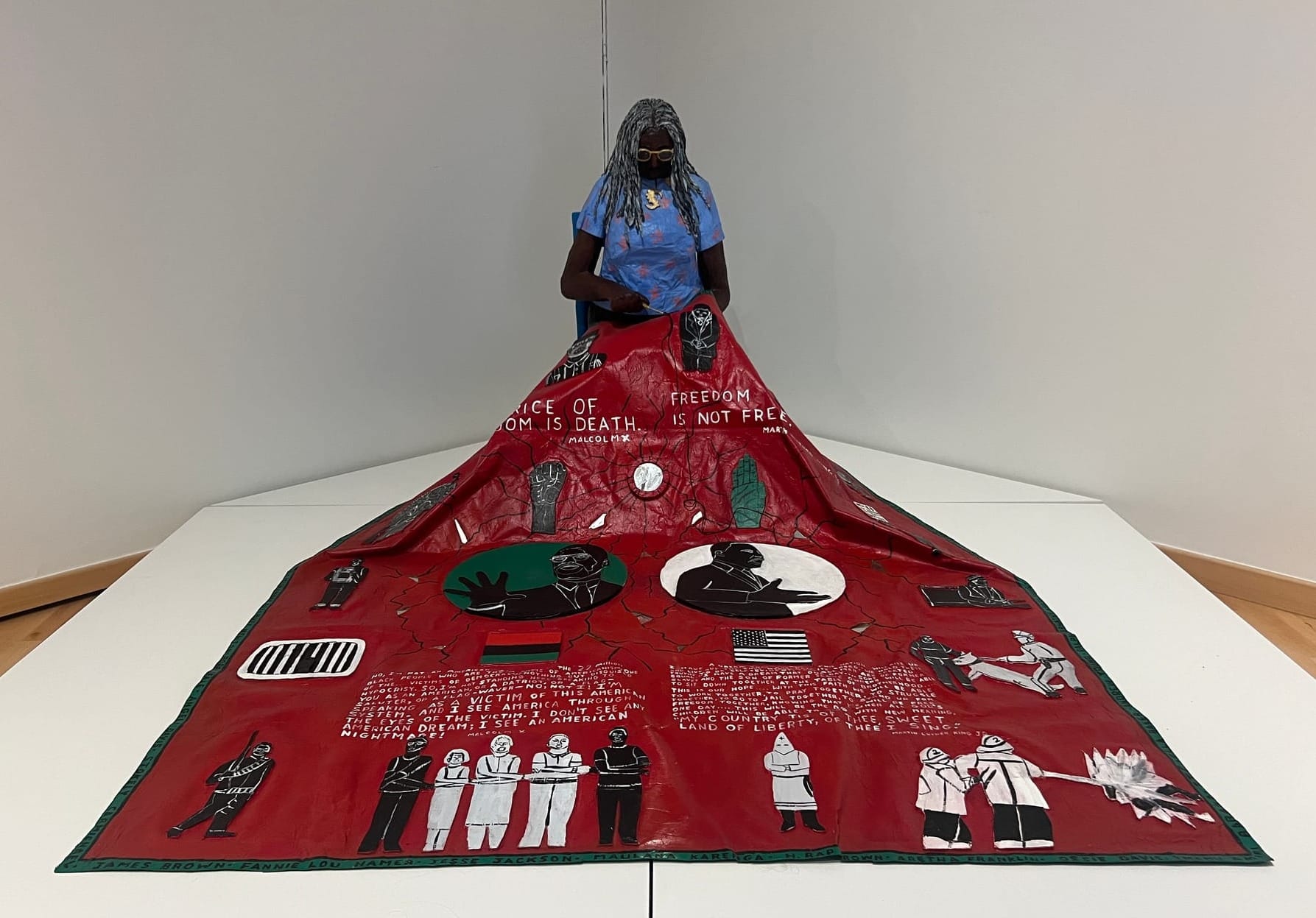
The final era of Birch's career is marked by life-size figures that animate the gallery space, as if sharing their own stories. These sculptures, ranging in size and hue, depict Black bodies in various poses, each one imbued with a unique aspect of Black existence. "Memories of the '60s" (1992), a grand quilt incorporating key events from the Civil Rights Movement, rests across the knees of a woman wearing a gold Gye Nyame, an Adinkra symbol representing praise to God.
This monumental piece, with its blend of serenity and gravity, serves as a compelling entryway to the artist's more recent works.
Written by urgent.news from Hyperallergic's reporting — not their text. Machine-written — may contain errors; check the original before relying on it.