For Mena youth, Arabic is the language of identity, but can it also become the language of opportunity?
The first white paper from the Congress of Arabic & Creative Industries in Abu Dhabi has found that young people want Arabic to keep pace with the way they learn, work and create. The thought piece, in partnership with Strategy& and Ipsos, marked the 5th Congress on September 20. For young people across the Middle East and North Africa, Arabic remains overwhelmingly the language of home, family…
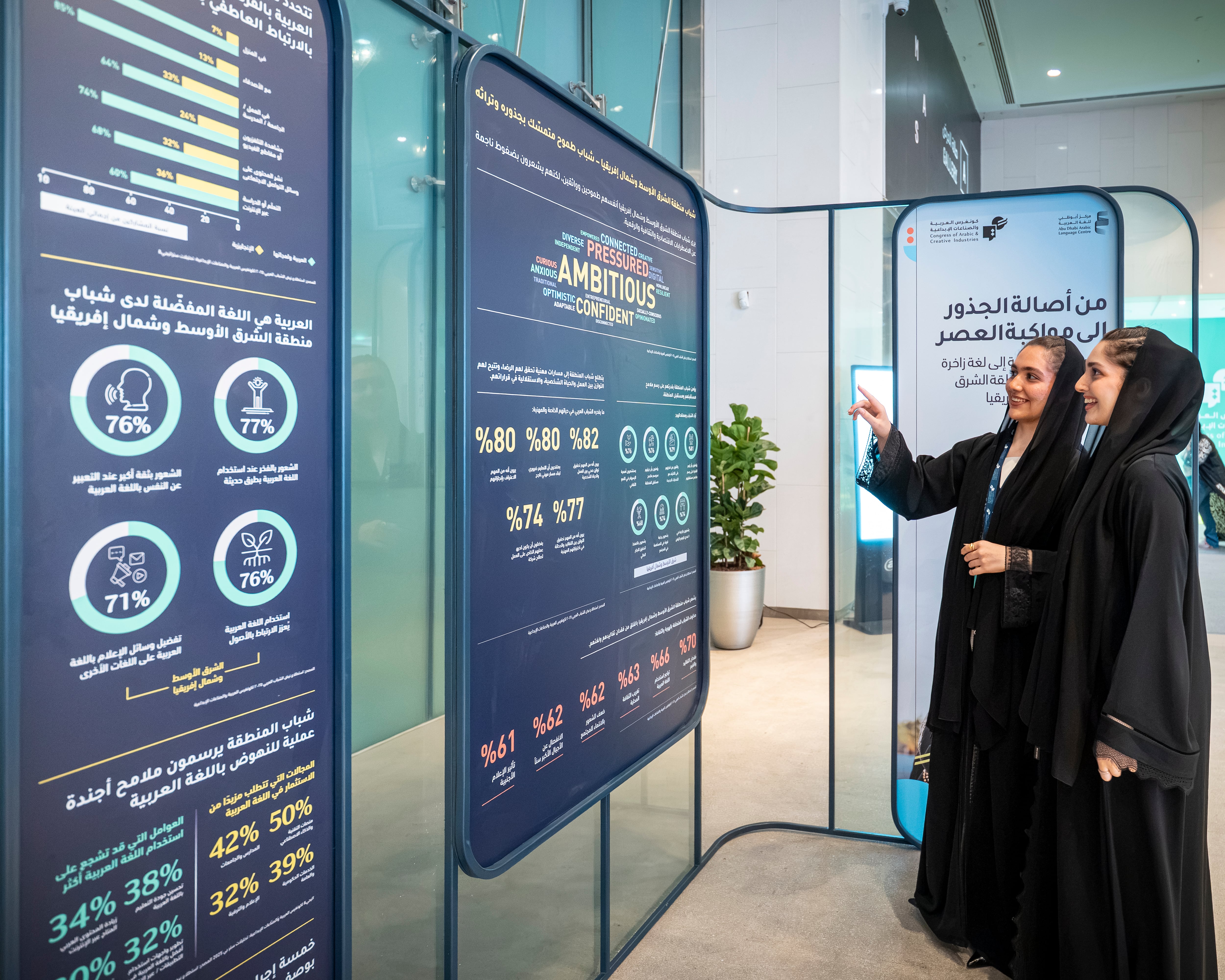
A recent report by the Congress of Arabic & Creative Industries in Abu Dhabi reveals that young people in the Middle East and North Africa (MENA) view Arabic as a crucial part of their identity, but also recognize its potential to become a language of opportunity. Conducted as part of the 5th Congress on September 20, the study involved over 4,000 young people aged 18 to 25 from 10 countries across the region.
While Arabic remains the dominant language at home and for connecting to roots, the report highlights a growing gap between its use and their aspirations in education, work, and digital environments.
The research found that while 91% of respondents use Arabic at home, this drops to 64% at work, university, or school, and 60% in online learning. English, on the other hand, jumps from 7% at home to 33% in education, 39% in government services, and 36% in online learning. Almost three-quarters (74%) of the young people surveyed want Arabic to evolve to better suit their learning, work, and creative pursuits.
Dr. Ali Bin Tamim, chairman of the Abu Dhabi Arabic Language Centre, emphasized that this is not a weakening of their connection to the language, but an expectation that Arabic keep pace with modern environments.
Technology emerged as the top priority for greater investment in Arabic, with half of the respondents identifying AI and artificial intelligence as the leading area needing more support. Currently, only 0.6% of websites online are in Arabic, despite 86% of young people aged 15 to 24 being online. The report also notes a lack of quality Arabic-language AI, with many large language models performing poorly in non-English contexts and struggling with cultural nuances.
The Abu Dhabi Arabic Language Centre, in partnership with Strategy& and Ipsos, calls for the development of a shared Arabic-language technology infrastructure, including high-quality datasets, language models, speech-recognition tools, and translation resources. Nay Abi Ramia, a partner at Strategy& Middle East, stressed the need to see Arabic as both a cultural and economic question, recommending investments in education, digital content, Arabic data, and AI tools.
By doing so, Arabic can become a language that young people not only identify with but also use to fully participate in the region's future economy.
Written by urgent.news from The National UAE's reporting — not their text. Machine-written — may contain errors; check the original before relying on it.
This story
This is one outlet's version. Read the fullest account.