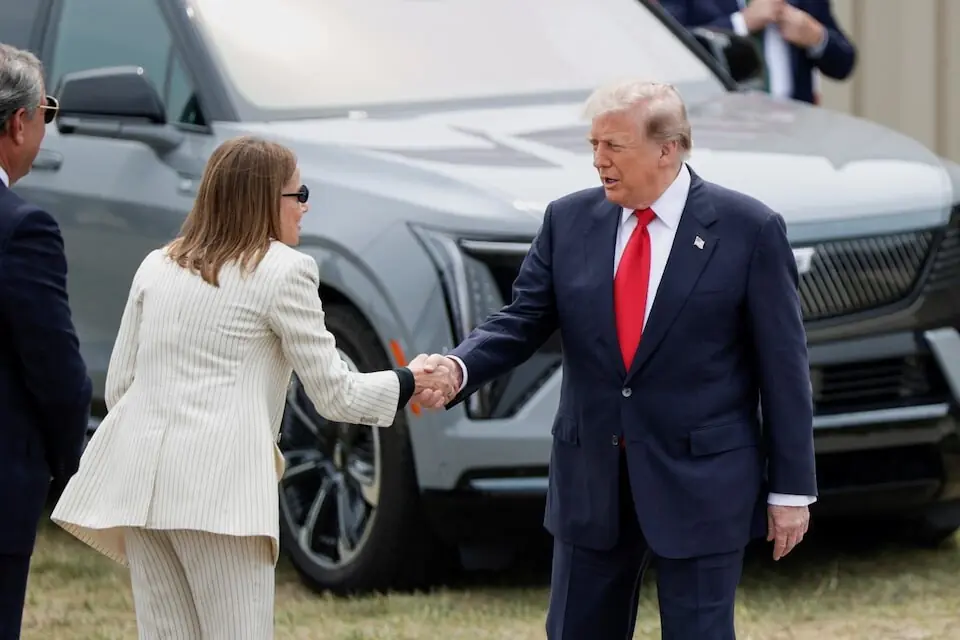
Der kanadische Premierminister Mark Carney bleibt im Handelsstreit mit den USA hart – fünf Gründe, wieso das funktioniert
Kaum ein Land ist in seinem Aussenhandel derart stark von den USA abhängig wie Kanada. Doch genau aus dieser Schwäche speist sich der Abwehrwille der Kanadier.

Canada is one of the countries most heavily reliant on trade with the United States, with 70% of its goods exports going to the US. This heavy dependence has fueled the Canadian resilience in the current trade dispute with the US, with Prime Minister Mark Carney emerging as the European champion. Since showing a clear edge in the trade dispute, Carney has been hailed as the best friend of Europeans.
However, unlike the EU, Carney abandoned the negotiations with Donald Trump in August and imposed counter-tariffs when the US did not budge enough from its maximum demands. Trump now threatens to impose new tariffs against Canada, set to take effect at the end of September. Carney's tough stance may seem paradoxical, given the US's importance to Canada's economy.
However, the heavy reliance on the US has made the Canadian fight spirit stronger. The EU or Switzerland may have a major but not decisive trading partner in the US, but for Canada, it's a matter of national sovereignty. The negative jokes and threats from Trump about making Canada the 51st state have led to a loss of trust, with Carney resigning his post being the only solution.
Tony Stillo, an expert for Canada at Oxford Economics, states that Canada is hit harder by Trump's reindustrialization strategy than Mexico, as the Canadian and American industries are very similar, making it easier for factories to relocate, while Mexico serves as a low-wage alternative. Carney's uncompromising stance is also supported by over two-thirds of the population.
Trump's disrespectful treatment of Canada's northern neighbor has made Canadians stand united, even among powerful provincial governors. In a federal country like Canada, this is not an easy feat, as provinces have divergent economic interests. The largest province, Ontario, wants to protect its strong industrial base, especially the southern auto production linked to Detroit in Michigan.
However, there are differences, with Alberta, the wealthy oil province, wanting to export as much oil and gas as possible and showing little interest in an economic war with Trump. Premier Danielle Smith wants to prevent Carney from using Alberta's energy exports as leverage in negotiations and imposing export tariffs, as Ontario's Premier Doug Ford suggested.
Nevertheless, Carney fares better as a villain compared to his climate-conscious predecessor Justin Trudeau, as he advocates for expanding Canada's oil and gas export capacity. Despite Alberta's independence referendum, which Alberta could barely win, the situation is relatively balanced, with Canada exporting $382 billion in goods to the US, compared to $334 billion in the opposite direction.
Energy products, including crude oil, processed oil products, natural gas, and electricity, account for 111 billion dollars or 29% of Canadian exports. Trump has decided not to impose tariffs on these energy exports, as it would increase inflation in the US. For important Midwestern gateways, higher gasoline prices would be detrimental, which the Republicans want to avoid before the midterm elections.
Excluding these 111 billion dollars in energy exports, the US would have a surplus in bilateral goods trade with Canada, meaning Canada would be at a disadvantage in the trade dispute with the US. Mark Carney set out to reduce Canada's dependence on the US and double exports to other countries by 2035 when he took office in March 2025.
"With the implementation of strategic key projects, this is possible," says Tony Stillo from Oxford Economics. Carney's government is negotiating new trade agreements with partners in Asia and Europe, streamlining licensing procedures, and accelerating infrastructure projects such as gas pipelines and terminals for liquefied natural gas exports.
Internally, Canada has also made progress under Carney's leadership, abolishing some barriers and rules that affected internal trade and the mobility of workers between provinces. While Carney's reforms will take time to take effect, they create a solid foundation to strengthen the country's long-term productivity and potential growth.
Canada's annual economic growth has recently been around 1%, with the second quarter being particularly weak. Investment is slowly picking up, long lagging behind.
Written by urgent.news from NZZ Wirtschaft's reporting — not their text. Machine-written — may contain errors; check the original before relying on it.