The science of Gaganyaan parachutes | Explained
Why does Gaganyaan need multiple parachutes? How are they tested?
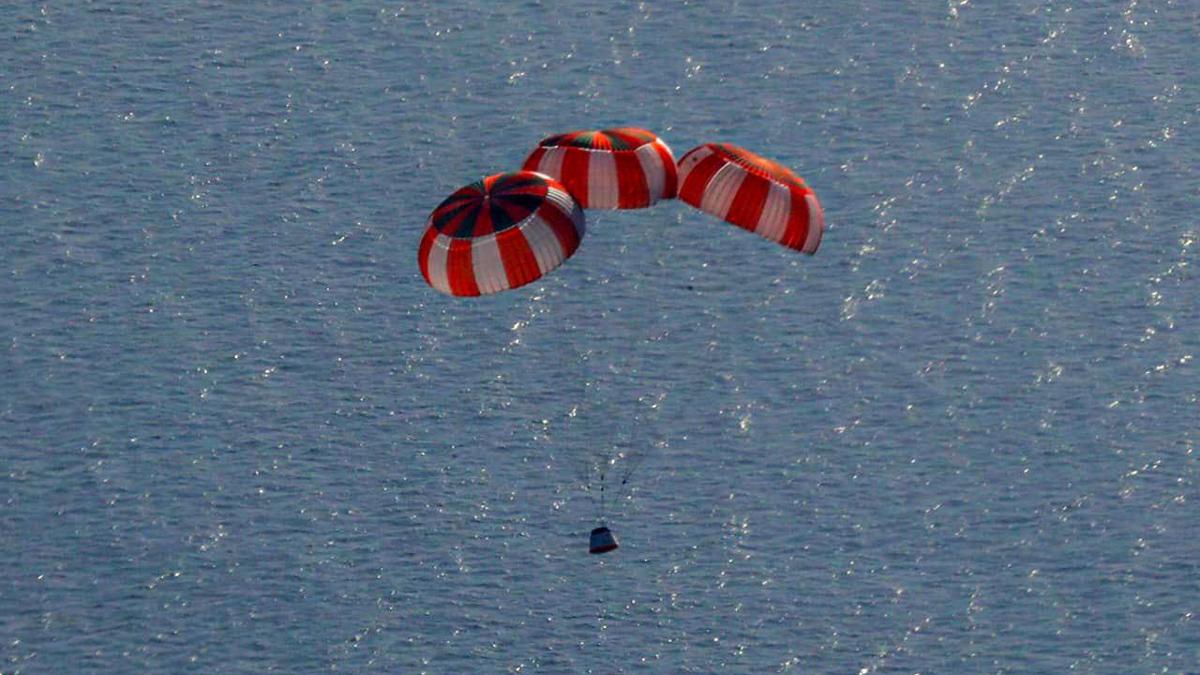
Spacecraft re-entering Earth’s atmosphere rely on atmospheric drag to slow down substantially, with parachutes activated in the terminal phase to further decelerate for a safe landing. Parachutes for crewed vehicles demand advanced engineering, employing multi-staging, redundancy, high-performance materials, and high-pressure packing to minimize storage space. The system consists of three types of chutes: pilot, drogue, and main.
The pilot chute, a mini-parachute, pulls out larger drogue or main chutes. The drogue chute stabilizes the module early in descent, reducing velocity. The main chute, larger with a wider canopy, is deployed in the final phase to reduce velocity to ensure a gentle landing. The blunt shape of the crew module generates a turbulent wake, necessitating parachute ejection through this wake.
Deployment must occur at subsonic speeds to prevent shockwave interaction and intense dynamic pressure from shredding standard canopies. The Gaganyaan crew module returns at about 170 m/s, faster than a Formula 1 car. Direct deployment of the full-sized main parachute at high speed would generate excessive opening shock, risking canopy shredding or lethal deceleration forces on the crew.
Thus, a multi-stage release of parachutes is employed, incrementally increasing the parachute diameter to reduce deceleration and dynamic pressure.
The parachute canopy mouth opens in steps, analogous to gradually opening an umbrella in strong winds. A strong cord is threaded through the chute’s skirt, with the cord's length determining the initial percentage of canopy opening. Attached to the cord is a reefing line cutter, a small tube containing a blade and chemical timer. Once deployed at safe speeds, the cutter releases the cord, allowing the canopy to fully bloom.
Testing occurs on various platforms like Rail Track Rocket Sled (RTRS) in Chandigarh or by dropping from helicopters or small rocket-powered test vehicles. Post-splashdown or landing, timely parachute detachment prevents wind from dragging the module or capsize in sea. Material selection prioritizes high tensile strength, thermal resistance, and low mass, with modern parachutes using advanced synthetic polymers.
Kevlar reinforces high-load suspension lines, Nomex withstands hot mortar gas discharge, and nylon provides elasticity for canopy broadcloths.
Redundant parachute clusters ensure safety, with ADRDE in Agra developing the technology.
Written by urgent.news from The Hindu - Sci-Tech's reporting — not their text. Machine-written — may contain errors; check the original before relying on it.