The Real Value of Event-Driven Architecture Isn't Technology: It's Cost Reduction
EDA is a strategic approach that helps organizations reduce costs, accelerate delivery, and improve scalability while maintaining flexibility for future growth.
In the realm of modern enterprise IT, the real value of Event-Driven Architecture (EDA) transcends mere technological implementation. Instead, the true advantage lies in its remarkable ability to slash costs across various facets of IT operations. As digital demands escalate and budgets shrink, traditional Request-Driven Architecture (RDA) often stumbles to keep pace.
The complexity of scaling integration, soaring infrastructure expenses, and mounting operational overhead render even minor modifications prohibitively expensive and time-intensive. This is precisely where EDA emerges as a transformative force. Far from being just a contemporary integration pattern, EDA represents a strategic methodology that empowers organizations to trim costs, expedite delivery, and bolster scalability while preserving the flexibility necessary for future expansion.
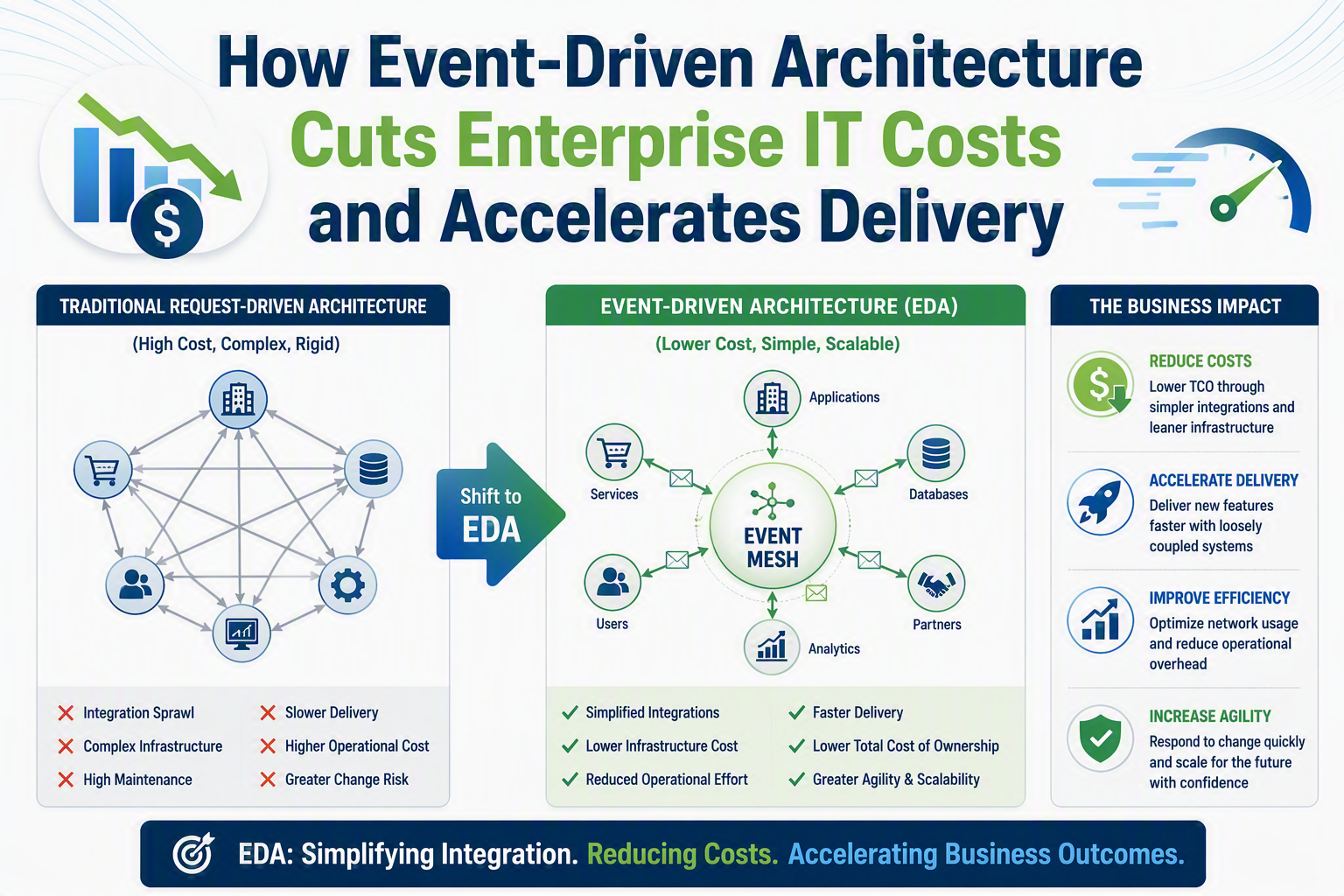
Traditional architectures burden enterprises with intricate infrastructures designed for point-to-point communications between applications. This landscape includes firewalls, load balancers, proxy servers, multiple network segments, and dedicated integration components. As the application count expands, so too does the supporting infrastructure, driving up hardware expenses, operational burdens, and complexity.
Coupled with tightly coupled point-to-point integrations, where each application must comprehend every other's connection specifics, protocol, data format, failure handling, retry mechanisms, and message buffering strategies, the integration sprawl becomes an escalating cost driver. Even minor alterations to a single data element may necessitate modifications and testing across a multitude of interdependent systems, culminating in heightened development costs, exhaustive no-harm testing requirements, extensive maintenance efforts, elevated implementation risks, protracted project timelines, amplified monitoring and compliance expenditures, and delayed change delivery.
The paramount cost in enterprise IT is not infrastructure or software licenses—it is the cost of change. As systems become increasingly interwoven and tightly coupled, every change becomes progressively costlier. EDA mitigates this challenge by facilitating independent evolution of systems, thereby curtailing the cost, effort, and risk associated with change.
Employing an Event Mesh to securely interconnect applications across diverse network environments while furnishing a scalable foundation for self-service integration, organizations can harness EDA in tandem with microservices, automation, and DevOps practices to orchestrate a markedly more efficient operating model.
The financial benefits of EDA are substantial. Firstly, integration costs are mitigated through the dismantling of traditional point-to-point integrations into simpler, reusable interfaces. Events can be shared across various services, obviating the need for bespoke integrations for each consuming application. This streamlined approach simplifies design, development, testing, support, and ongoing maintenance, yielding a lower Total Cost of Ownership (TCO).
Secondly, EDA curtails infrastructure expenses by leveraging a unified messaging platform. Capabilities such as exclusive queues, non-exclusive queues, and publish/subscribe messaging enable significant reductions in the need for additional load balancers, complex integration gateways, and dedicated communication infrastructure, resulting in lower hardware investments, diminished software licensing costs, and simplified infrastructure management.
Moreover, EDA optimizes network and bandwidth usage by transmitting events only when changes occur, rather than incessantly exchanging request/response messages or data synchronization payloads. Consumers subscribe solely to the events pertinent to them, leading to smaller message sizes, reduced network traffic, decreased bandwidth consumption, and enhanced overall efficiency—directly translating into lower infrastructure and operational costs.
Simultaneously, the reduced operational complexity in an EDA environment, with applications communicating through the event mesh rather than maintaining direct relationships with numerous systems, simplifies operations. Teams no longer need to manage extensive dependencies or firewall rules among applications, culminating in simpler architecture, reduced operational effort, swifter problem resolution, lower support costs, improved system scalability, and accelerated delivery times that culminate in lower overall costs.
Lastly, EDA's emphasis on faster delivery translates into reduced costs, as systems' loose coupling allows for independent team work, new consumers' subscription without producer impact, less regression testing, and capability evolution at individual paces. This culminates in faster time-to-market, lower project costs, reduced implementation risk, and heightened business agility.
Consequently, the reusability and economies of scale afforded by EDA—where events can be leveraged by multiple consumers simultaneously, with the cost of production remaining relatively constant while the business value generated by each event escalates—further accentuate the architecture's cost-reduction prowess.
Written by urgent.news from HackerNoon's reporting — not their text. Machine-written — may contain errors; check the original before relying on it.