How the Digital Attention Economy Has Taken Over Our Real-World Lives
When I visited the Louvre Museum in Paris, I was struck by how small the Mona Lisa looked in person—a common reaction—and by how most of the people in the room were not looking at the painting itself. They were
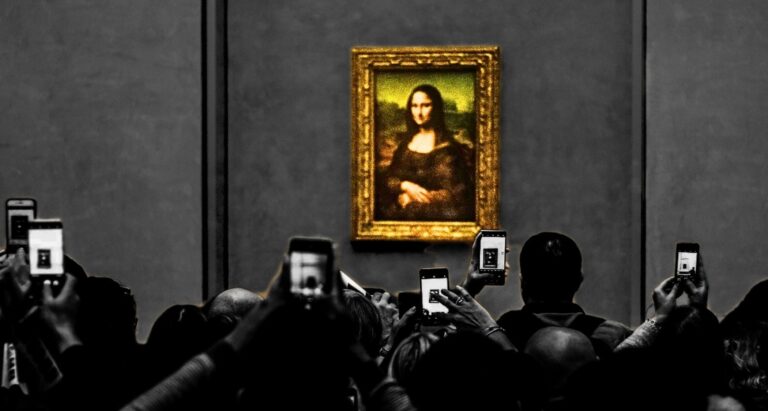
The Louvre Museum in Paris serves as an example of how the digital attention economy has infiltrated our real-world lives. Upon arrival, the visitor is struck by the diminutive size of the Mona Lisa, a common reaction, and notices that most others in the room are preoccupied with capturing the painting on their phones. The thick protective glass causes reflections, making it difficult to see the painting clearly, yet the focus remains on capturing the moment rather than appreciating it directly.
This behavior reflects a shift from experiencing art to seeking recognition for the act of witnessing it.
Prior to visiting, attendees likely envisioned their goal as witnessing the art, but in reality, they are more focused on documenting the experience for others. This phenomenon extends beyond museums. At concerts, audiences watch performances through raised screens, concentrating on their framing rather than the artist. At scenic overlooks, people turn away from the landscape to take selfie photos.
During children's school performances, parents watch their child on a screen, despite the child being right in front of them, demonstrating an obsession with capturing the moment rather than fully engaging in it. Parents, too, watch performances through phone screens, even though the child is directly in front of them, highlighting a preoccupation with verification over documentation.
The audience has evolved from a passive receiver of content to an active participant, shaping the performance as it unfolds. This constant presence of an audience, both physically and mentally, has led to a redefinition of human behavior. Psychologists have observed that people alter their actions when they feel observed, and modern digital life has transformed this natural response into a permanent condition.
The "looking glass self," a concept proposed by sociologist Charles Horton Cooley, describes how individuals form their identity based on how they believe others see them. In the digital age, this process is industrialized through constant feedback signals, leading to an ongoing cycle of self-observation and adjustment.
Politicians pause to consider audience reactions, journalists monitor engagement metrics, and educators tailor lectures for online circulation. Live streamers modify their content based on live chat feedback, and even everyday conversations are influenced by the anticipation of reaction. This constant need for validation reshapes public behavior, with creators and individuals alike adjusting their actions to ensure their identity is visible and appreciated.
The audience's influence is pervasive, present even in the absence of others, and its impact on behavior is both subtle and profound.
Written by urgent.news from Literary Hub's reporting — not their text. Machine-written — may contain errors; check the original before relying on it.