How Hong Kong can keep the talking going when US-China officials don’t
When Tung Chee-hwa died, the obituaries predictably described a Hong Kong shipping mogul who became the city’s first postcolonial chief executive. How his government navigated the Asian financial crisis and severe acute respiratory syndrome (Sars) epidemic and its retreat from Article 23 were highlighted. There was less attention paid to the political hybrid he embodied. Tung sat as vice-chairman…
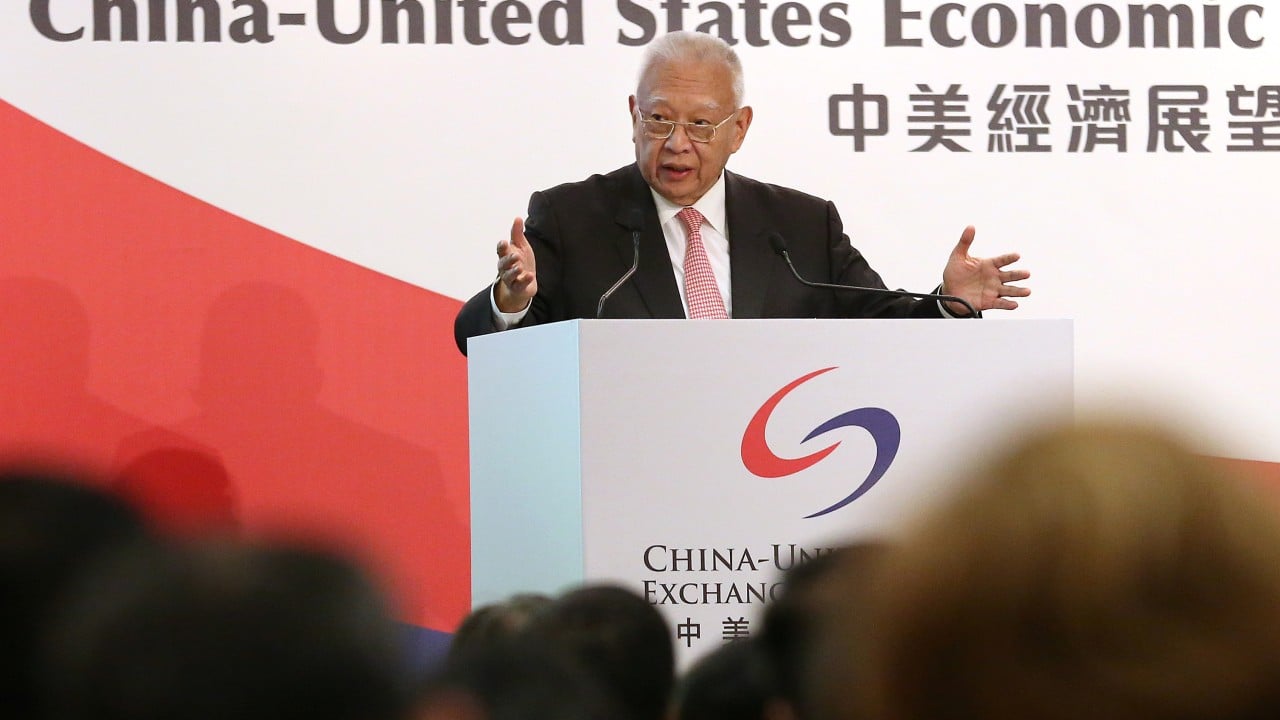
When Hong Kong's former leader Tung Chee-hwa passed away, news outlets naturally focused on his role as the city's first post-colonial chief executive. However, his tenure was marked by navigating the Asian financial crisis and the Severe Acute Respiratory Syndrome (SARS) epidemic, as well as his retreat from Article 23. The political hybrid Tung embodied was less discussed.
Apart from being the vice-chairman of China's top political advisory body, he also established the China-United States Exchange Foundation in Hong Kong in 2008, marking the 30th anniversary of Sino-US relations. This private vehicle was used to facilitate communication between senior Americans and Chinese when their governments were unresponsive, a practice known as Track 1.5.
At a recent Track 1.5 Dialogue in Beijing, Liu Haixing, head of the Communist Party’s International Department, suggested that both countries should expand the "pie" of shared interests and avoid zero-sum games to achieve "normal stability with controllable disagreements." This represents realistic ambition, rather than simply a friendship or a breakup.
Track 1.5 is a mix of official governmental negotiation and purely unofficial civil society dialogue. Participants, including former officials, scholars, and trusted business figures, engage in unofficial discourse, moving faster than foreign ministries, without bureaucratic protocol or legislative oversight. This format is particularly useful when formal negotiations freeze.
Hong Kong should pay more attention to this system than other Asian cities, and stop viewing it as something happening elsewhere, about Hong Kong, rather than here, because of Hong Kong. As downstream of these conversations, Hong Kong-registered entities are on the front lines of American trade enforcement. Semi-official dialogue is where boundaries get set before any designation occurs, and where the specifics of how export controls affect a hub like Hong Kong get analyzed.
Three avenues are suggested to maintain communication. First, research and development in areas like climate, public health, ageing, and learning science, where mainland universities and American ones hesitate to sign directly. Hong Kong institutions can host laboratories, hold data, and lead steering committees. Second, institutions with standing in both capitals, such as the Yidan Prize Foundation, can facilitate semi-official contact.
Third, student-to-student exchange programs can rebuild ties between the two nations. Today, fewer than 2,000 Americans study in mainland China, compared to around 11,000 in 2019. Hong Kong, with its English-speaking environment and proximity to Shenzhen, is a credible place to rebuild these connections. Plans to allow non-locals to make up half of the local university cohort are an invitation Hong Kong has not yet fully embraced.
Track 1.5 is not just one conference; it is the critical mass of events that make a city the default choice for such discussions.
Written by urgent.news from Reuters Business via SCMP's reporting — not their text. Machine-written — may contain errors; check the original before relying on it.